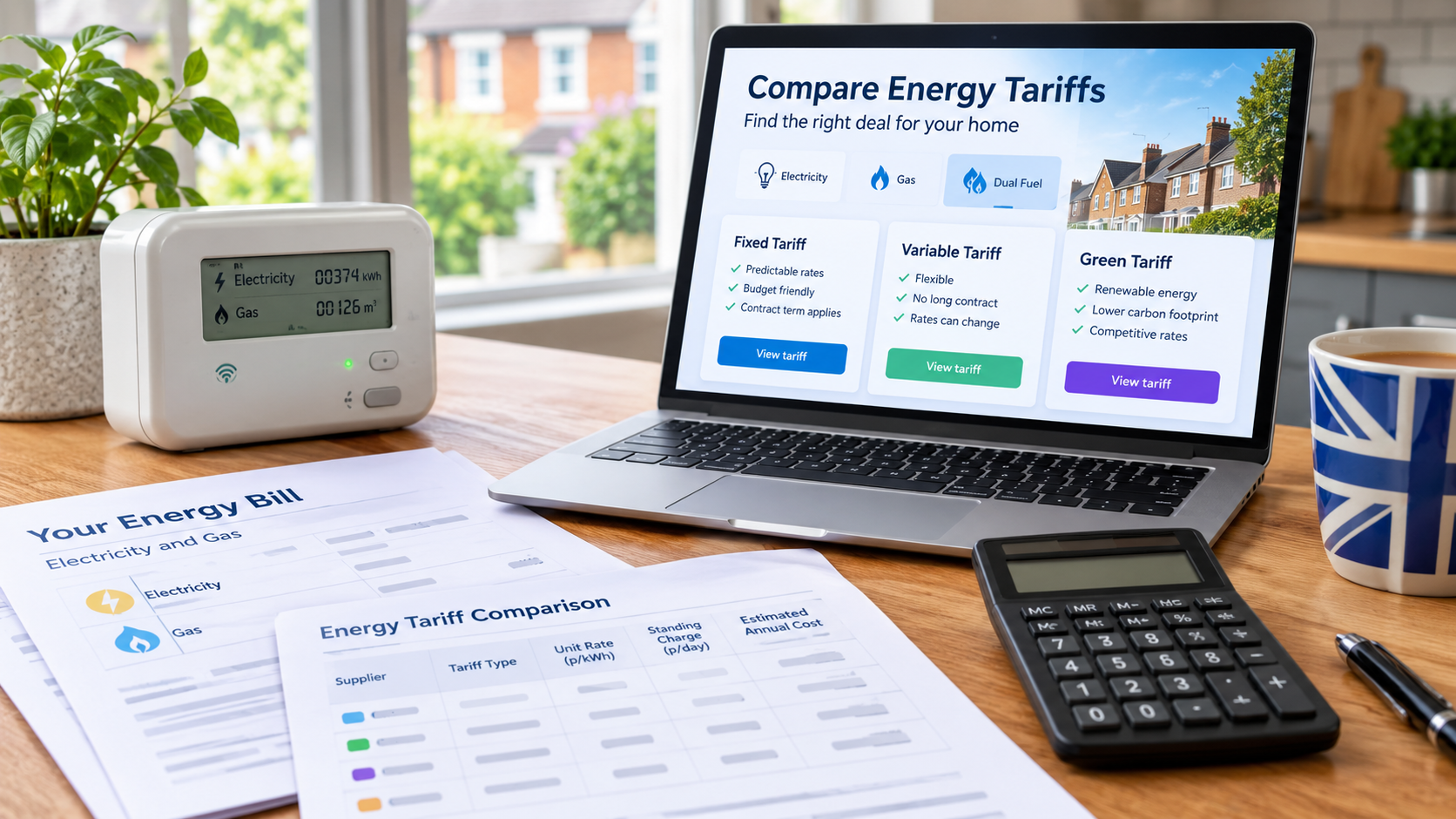
Best Energy Tariffs in the UK: How to Compare Prices in 2026
Rising household expenses make choosing an energy tariff an important part of managing your monthly budget. If your gas and electricity bills seem expensive, you may be able to reduce your costs by reviewing your current deal, comparing suppliers and choosing a tariff that matches your energy usage.
Finding the best energy tariff in the UK is not simply about choosing the lowest advertised price. Your postcode, annual electricity and gas consumption, meter type, payment method and contract terms can all affect the deal available to you.
As of October 2026, Ofgem’s energy price cap for a typical dual-fuel household paying by Direct Debit is £1,723 a year for the period from 1 October to 31 December 2026. This is an illustrative annual figure, not a fixed bill or a maximum amount every household can spend. Your actual costs depend on how much energy you use and where you live.
This guide explains UK energy tariffs, the latest published price-cap figures, the differences between fixed and variable deals, and the practical steps you can take to compare energy prices.
What Are UK Energy Tariffs?
An energy tariff is the pricing plan your supplier uses to charge you for electricity, gas or both. It normally includes two important costs:
- Unit rate: The amount you pay for each kilowatt-hour (kWh) of energy you consume.
- Standing charge: A daily fee for maintaining your connection to the electricity or gas network, regardless of how much energy you use.
Your annual bill depends on both charges, along with your energy consumption and the terms of your tariff.
For example, a household that uses a lot of electricity may benefit more from a lower electricity unit rate. A household that uses very little energy may need to pay closer attention to the standing charge because it forms a larger proportion of the total bill.
Comparing these costs together gives you a more realistic picture of which deal may offer better value.
Energy Prices UK: Latest Ofgem Price Cap
Ofgem regulates the maximum unit rates and standing charges suppliers can charge customers on covered default tariffs. The cap is reviewed every three months.
For the period from 1 October to 31 December 2026, the published average rates for Direct Debit customers in England, Scotland and Wales are:
| Cost | Published rate |
|---|---|
| Electricity unit rate | 26.32p per kWh |
| Electricity standing charge | 54.83p per day |
| Gas unit rate | 7.97p per kWh |
| Gas standing charge | 29.68p per day |
| Typical annual dual-fuel price-cap figure | £1,723 |
The figures above are based on Ofgem’s published price-cap information. Electricity and gas rates include different VAT treatment: electricity is shown without VAT for this period, while the gas figure includes 5% VAT. Check Ofgem’s regional tables for the applicable rates and tax treatment when comparing actual offers.
The £1,723 figure is based on a typical household’s estimated annual consumption. It is not a limit on the total bill for a household that uses more energy.
The price cap applies to covered default tariffs, not every fixed-rate deal. If you have a fixed tariff, the agreed rates generally remain in place for the contract period, subject to its terms.
Important: These rates apply to the stated October–December 2026 period. Check the latest official figures before making a decision for a later period.
Official source: Ofgem energy price cap rates.
Types of Energy Tariffs Available in the UK
Different tariffs suit different households. Before switching, understand how each option works and what risks it carries.
1. Fixed Energy Tariffs
A fixed energy tariff keeps the agreed unit rates and standing charges unchanged for the contract period, although your total bill still varies with usage.
For example, if you agree to an electricity rate of 24p per kWh, that rate generally stays the same throughout the contract. Using more electricity will still increase your bill.
Advantages
- More predictable unit rates and standing charges.
- Protection against increases in the underlying market price during the fixed period.
- Easier household budgeting.
- Potential savings when the agreed rates compare favourably with other deals.
Disadvantages
- You may pay more than customers on variable tariffs if market prices fall.
- Some contracts have exit fees for leaving early.
- The cheapest advertised deal may not be available in your area or for your meter type.
A fixed tariff may suit households that value predictable rates and want to reduce uncertainty. Compare the complete estimated annual cost rather than relying on the word “fixed” or an introductory offer.
2. Standard Variable Energy Tariffs
A standard variable tariff, also known as a default tariff, has rates that can change over time. Suppliers usually adjust covered default rates in line with changes to the Ofgem price cap.
Advantages
- Flexibility to change tariffs without a fixed-term commitment in many cases.
- No long-term commitment to a particular rate.
- Potential benefit when variable rates fall.
Disadvantages
- Rates may increase when the price cap changes.
- Household energy costs can be harder to predict.
- Another supplier may offer a more suitable fixed deal.
A variable tariff can be reasonable if you want flexibility or prefer not to lock into current prices. However, it is worth checking available alternatives rather than assuming your existing tariff is competitive.
3. Time-of-Use and Economy Tariffs
Time-of-use tariffs charge different electricity rates at different times. Some offer lower rates overnight or during other off-peak periods.
Economy 7 is a familiar example, while some smart tariffs are designed for electric vehicle charging, heat pumps or flexible household electricity use.
These tariffs may be useful if you can move a significant amount of electricity consumption to cheaper periods.
For instance, a household that charges an electric vehicle overnight may benefit from a lower off-peak rate. However, the saving depends on the tariff’s peak rate, off-peak hours, standing charge and how much electricity is used at each time.
Advantages
- Potential savings for households with flexible electricity use.
- Useful for overnight charging or certain heating systems.
- May reward shifting electricity consumption away from peak periods.
Disadvantages
- Peak rates can be higher than a single-rate tariff.
- Cheap hours may not match your daily routine.
- Some tariffs require a compatible meter or smart meter.
Before switching, check the exact off-peak hours and confirm that your meter is compatible.
4. Green Energy Tariffs
Green tariffs are designed to support renewable electricity or other lower-carbon energy arrangements. However, the label alone does not tell you precisely how a supplier sources or matches the energy it sells.
Read the supplier’s explanation of its renewable electricity arrangements, any environmental certificates and the contract terms.
Advantages
- May align with your environmental priorities.
- Can offer standard fixed or variable pricing structures.
- Some deals support customers who want to consider environmental factors alongside cost.
Disadvantages
- A green tariff is not automatically the cheapest option.
- Environmental claims and arrangements differ between suppliers.
- Some green variable tariffs may not be covered by the Ofgem price cap, so check the terms carefully.
Compare the actual rates and understand what the supplier means by renewable energy before choosing.
Best Energy Tariff UK: What Should You Compare?
There is no single tariff that is cheapest for every household. The most useful comparison is based on your own consumption and the deals available at your address.https://s
Unit Rates
The unit rate is the price you pay for each kWh of electricity or gas. If you use a large amount of energy, even a small difference in the unit rate can affect your annual bill.
Check electricity and gas rates separately when comparing dual-fuel offers. A supplier with a low electricity rate may have a less competitive gas rate, or vice versa.
Standing Charges
Standing charges apply even when you use no energy. They can be particularly important for properties with low consumption or periods when nobody is home.
Do not choose a tariff based only on a low unit rate. A higher standing charge could reduce or eliminate the apparent saving.https://www.citizensadvice.org.uk/consumer/energy/energy-supply/get-a-better-energy-deal/switching-energy-supplier/
Estimated Annual Cost
Use your actual annual electricity and gas consumption, measured in kWh, wherever possible. This is usually more useful than comparing suppliers’ example monthly payments.
For a simple comparison:
Estimated annual cost = annual energy consumption × unit rate + 365 × daily standing charge
Calculate electricity and gas separately, then add the results. Include any applicable discounts or fees only when their conditions are clear.
Contract Length and Exit Fees
Check how long a fixed deal lasts and whether you would pay a fee to leave early. A deal that looks cheaper today may be less attractive if you expect to move home or want flexibility.
Review the end date of your existing contract and any rules about switching before it expires.
Customer Service and Billing
Price is important, but so is the supplier’s ability to handle billing questions, meter readings and complaints. Look at independent customer service information and confirm that the supplier supports your meter and payment arrangement.
Payment Method and Meter Type
The tariff options available to you can depend on whether you pay by Direct Debit, receive bills after using energy or have a prepayment meter.
Do not assume a quoted rate applies to every payment method. Check the actual offer for your circumstances.
How to Compare Energy Suppliers and Switch
You can review tariffs from your current supplier as well as other providers. Switching to another deal with your existing supplier may be worth considering if it offers suitable rates and terms.
Follow these steps:
- Find your current tariff. Check your latest bill or online account for your tariff name, unit rates and standing charges.
- Record your annual usage. Use actual kWh figures from recent bills rather than relying solely on a monthly payment amount.
- Check your postcode. Regional rates and available tariffs can differ.
- Compare several offers. Review estimated annual costs, contract lengths, exit fees and payment requirements.
- Check the tariff details. Confirm that the offer works with your meter and electricity usage pattern.
- Review the contract. Understand the rates, fees and cancellation conditions before agreeing.
- Keep a record of the switch. Take a meter reading around the changeover date when appropriate and check your final bill.
Citizens Advice recommends checking whether the proposed deal suits your circumstances and comparing tariffs carefully. Switching may not always be the right choice, particularly if an exit fee outweighs the likely savings.
Read the official Citizens Advice guide to switching energy suppliers.
Practical Ways to Reduce Your Energy Bills
Changing your tariff is only one way to manage energy prices in the UK. You can also review how and when you use electricity and gas.
Reduce Unnecessary Energy Use
Turn off equipment when it is not needed, avoid heating unused rooms unnecessarily and use efficient lighting where practical. Small changes may help, although the result depends on your household’s starting point and energy consumption.
Use Off-Peak Electricity When It Makes Financial Sense
If you have a suitable time-of-use tariff, consider running flexible appliances or charging an electric vehicle during cheaper periods. Always compare the full tariff, because a low off-peak rate does not guarantee a lower overall bill.
Review Your Heating Settings
Heating and hot water can make up a substantial part of household energy use. Check your heating schedule and temperature settings, and consider whether draught-proofing or insulation improvements are appropriate for your property.
Check for Financial Support
If you are struggling with energy costs, contact your supplier to discuss support options and repayment arrangements. Depending on your circumstances, you may also qualify for government or local assistance.
Avoid assuming that a particular grant or discount is available to everyone. Check eligibility and current programme details through official sources.
Pros and Cons of Switching Energy Tariffs
Pros
- You may find a tariff with a lower estimated annual cost.
- A suitable fixed deal can provide greater certainty about unit rates.
- A time-of-use tariff may reward flexible electricity consumption.
- Reviewing tariffs can help identify expensive standing charges or unsuitable terms.
Cons
- Some fixed tariffs include early-exit fees.
- A fixed deal may become less competitive if market prices fall.
- Estimated savings depend on actual usage and regional rates.
- Not every advertised tariff is available to every household.
The right decision depends on the cost, flexibility and conditions of the specific deal rather than the tariff label alone.
Author/Expertise Note
This article is intended as general consumer information, not personalised financial advice. Energy prices and contract terms can change. The article’s UK price-cap figures should be checked against Ofgem’s official publications before republication or use after the stated period. An energy-market specialist should review any additional claims about supplier pricing, regulation or financial assistance.
Last Updated
21 October 2026. Ofgem’s published energy price-cap information for 1 October–31 December 2026 was reviewed for this article. Individual supplier tariffs may change more frequently.
FAQs
1. What is the best energy tariff in the UK in 2026?
The best tariff depends on your postcode, energy consumption, meter type and preferences. Compare current fixed and variable offers using your actual annual kWh consumption and check both unit rates and standing charges.
2. Is a fixed energy tariff cheaper than a variable tariff?
Not always. A fixed tariff can provide predictable rates and may offer savings, but a variable tariff may become cheaper if market prices fall. Compare the total estimated cost and contract conditions before deciding.
3. What is the UK energy price cap in October 2026?
For 1 October to 31 December 2026, Ofgem’s price cap is £1,723 per year for a typical dual-fuel household paying by Direct Debit in England, Scotland and Wales. It is an illustrative annual figure, not a limit on an individual household’s total bill.
4. Can I switch energy suppliers at any time?
Customers on standard variable tariffs can generally switch at any time. Customers on fixed deals should check the contract and any exit fees. Citizens Advice explains that fixed-tariff customers can generally switch without an exit fee when they have 49 days or less remaining, subject to the applicable rules and contract terms.
5. How can I compare energy prices accurately?
Use your postcode, annual electricity and gas consumption, payment method and meter type. Compare unit rates, standing charges, estimated annual costs and exit fees rather than relying only on monthly payment estimates.
6. What is an energy standing charge?
A standing charge is a daily fee for maintaining your energy supply, even if you use no gas or electricity that day. Its amount depends on factors including your region and tariff.
7. Are green energy tariffs always more expensive?
No. Pricing varies between suppliers and products. Compare the rates, standing charges and contract terms, and review how the supplier describes its renewable energy arrangements.