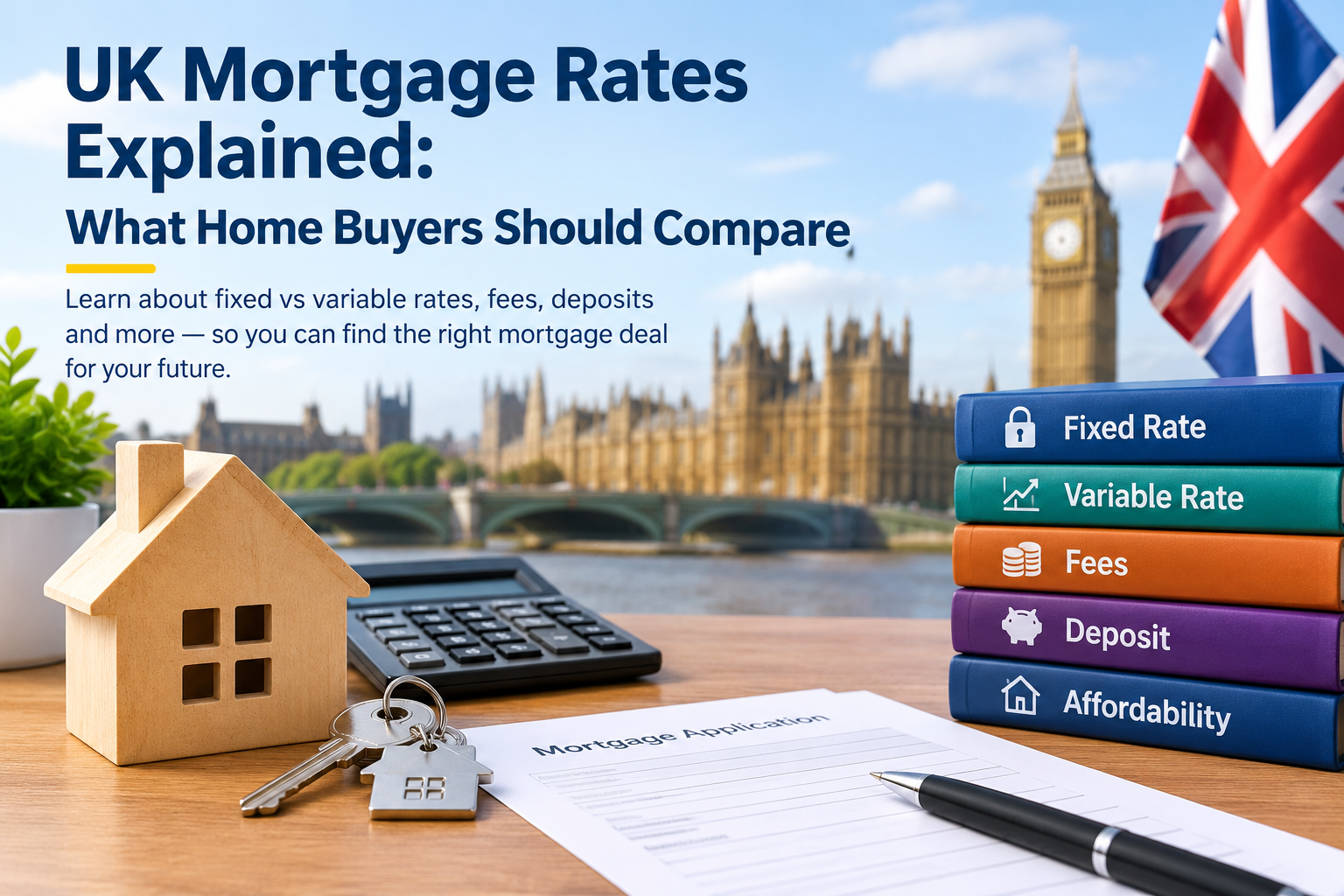
UK Mortgage Rates in 2026: How to Compare Deals and Calculate Your Repayments
Buying a home is one of the biggest financial commitments most people make. Even a small difference in your mortgage interest rate can change your monthly repayments and the amount of interest you pay over the life of the loan.
The good news is that you can estimate your costs before applying. By understanding UK mortgage rates and using a mortgage calculator, you can compare different borrowing amounts, repayment periods and interest rates to see what fits your budget.
The key takeaway: Do not choose a mortgage based on its advertised rate alone. Consider the arrangement fee, your deposit, the length of the deal, your monthly budget and what could happen when the introductory rate ends.
This guide explains how UK mortgage rates work, how to calculate repayments, what affects the deals available to you and how to compare your options.
What Are the Current UK Mortgage Rates?
UK mortgage rates vary between lenders and borrowers. There is no single rate available to everyone.
According to the Bank of England’s Money and Credit statistics, published in September 2026, the effective interest rate on newly drawn UK mortgages was 4.60% in August 2026, compared with 4.45% in July. This is a historical market-wide measure of interest actually paid on newly drawn mortgages, not a live rate quote or the cheapest deal currently available.
The Bank of England’s Bank Rate was 3.75% following its September 2026 decision. Bank Rate influences borrowing costs, but mortgage providers also consider market funding costs, competition, risk and the characteristics of each application.
Sources: Bank of England, Money and Credit — August 2026, and its September 2026 Bank Rate announcement.
Before relying on any advertised rate, check the lender’s current product details, eligibility requirements, fees and offer validity. Mortgage products can change quickly.
Why mortgage rates differ
The rate you may qualify for depends on several factors:
- Deposit size: A larger deposit generally means a lower loan-to-value ratio, which may give you access to more competitive rates.
- Credit history: Your credit record and existing financial commitments can affect the products available to you.
- Loan amount and property value: Lenders price products according to their lending criteria and the risk associated with the loan.
- Mortgage type: Fixed, tracker and other variable-rate products work differently.
- Mortgage term: The length of the loan affects monthly repayments and total interest.
- Fees: A product with a lower headline rate may cost more overall if it has a substantial arrangement fee.
For example, a buyer with a 25% deposit may have access to different deals from someone borrowing 95% of a property’s value. However, the actual difference depends on the lender and the products available when they apply.

How to Use a Mortgage Calculator UK
A mortgage calculator helps you estimate monthly repayments before you commit to a loan.
You generally need four pieces of information:
- The amount you want to borrow.
- The annual interest rate.
- The mortgage term in years.
- The repayment type, such as repayment or interest-only.
For a repayment mortgage, your monthly payment covers interest and gradually pays off the amount borrowed. For an interest-only mortgage, the regular payment covers interest, while the original capital remains outstanding.
You can use the free MoneyHelper mortgage repayment calculator to explore different borrowing amounts and interest rates.
Example: Calculate monthly mortgage repayments
Suppose you want to borrow £200,000 over 25 years on a repayment mortgage.
The following figures are illustrative calculations, not advertised mortgage offers.
| Illustrative annual rate | Estimated monthly repayment |
|---|---|
| 3.5% | £1,001 |
| 4.0% | £1,056 |
| 4.5% | £1,112 |
| 5.0% | £1,169 |
| 5.5% | £1,228 |
Assumptions: £200,000 borrowed, 25-year repayment term, fixed illustrative interest rate throughout, monthly repayments and no fees. Figures are rounded. Actual lender calculations and payment schedules may differ.
The comparison shows why stress-testing your budget matters. At these assumptions, the monthly payment at 5.5% is approximately £116 higher than at 4.5%.
Over a long mortgage term, interest-rate differences can add up to a substantial amount. Your actual cost will depend on the rate you pay over time, fees, overpayments and whether you refinance or change products.
How is a mortgage repayment calculated?
For a standard repayment mortgage, the monthly payment is calculated using the loan amount, monthly interest rate and number of monthly payments.
The standard formula is:
Monthly repayment = P × r × (1 + r)ⁿ ÷ [(1 + r)ⁿ − 1]
Where:
- P is the amount borrowed.
- r is the monthly interest rate, calculated from the annual rate.
- n is the total number of monthly payments.
For example, a 4.5% annual rate corresponds to a monthly rate of 0.045 ÷ 12 for this calculation.
A calculator does the arithmetic for you. Its value is in letting you change one assumption at a time and see how your repayments respond.

What Affects UK Mortgage Rates?
Mortgage pricing is influenced by the wider economy as well as your personal circumstances.
1. Bank of England Bank Rate
Bank Rate influences the interest rates banks charge and the rates they pay on savings. Changes can affect tracker mortgages directly, depending on their terms, and may influence standard variable rates.
However, fixed mortgage rates do not automatically move by the same amount as Bank Rate. They are also affected by market expectations, swap rates, lender funding costs and competition.
A rate cut does not guarantee that every mortgage deal will become cheaper, just as a rate increase does not necessarily cause every fixed-rate product to rise immediately.
2. Your loan-to-value ratio
Loan-to-value, or LTV, compares your mortgage borrowing with the property’s value.
For example, if a home costs £250,000 and you have a £50,000 deposit:
- Property price: £250,000
- Deposit: £50,000
- Mortgage: £200,000
- LTV: 80%
A lower LTV can help you qualify for more competitive mortgage products. To reduce your LTV, you could save a larger deposit, buy a less expensive property or, in some circumstances, reduce your outstanding mortgage balance.
Do not use every available pound for your deposit if it leaves you without money for moving costs, repairs and emergencies.
3. Your credit profile and affordability
Lenders usually examine income, regular expenses, outstanding credit commitments and evidence that you can afford repayments.
They may also assess employment arrangements, the source and reliability of income, the property and the mortgage term.
A commonly quoted borrowing guide is around 4.5 times annual income, but this is not a guaranteed entitlement or a universal lending limit. A lender may offer less—or assess an application differently—depending on its criteria and your circumstances.
Use a mortgage affordability calculator as a starting point, not as confirmation that your application will be approved.
4. The wider economic outlook
Inflation, economic growth, employment conditions and financial-market expectations all influence mortgage pricing.
This is one reason it is difficult to predict exactly where mortgage rates will be in six or twelve months. Forecasts can help explain market expectations, but they are not guarantees.
If you are buying a home, it is safer to test whether the repayments would remain manageable at a higher rate than to rely on a forecast that rates will fall.
Fixed vs Variable Mortgage Rates: Which Should You Compare?
The main choice is often between securing an interest rate for a set period and accepting a rate that can change.
Fixed-rate mortgages
A fixed-rate mortgage keeps the interest rate unchanged for an agreed introductory period, commonly two or five years, although other terms exist.
Advantages
- Predictable payments during the fixed period.
- Easier household budgeting.
- Protection from increases in the applicable rate during that period.
Disadvantages
- You may not benefit if comparable rates fall.
- Early repayment charges may apply if you leave the deal early.
- Your payments may rise when the fixed period ends.
A fixed rate may suit buyers who value certainty and need to plan household spending around a stable mortgage payment.
Tracker mortgages
A tracker mortgage follows a specified reference rate, commonly Bank Rate, plus or minus an agreed margin.
Advantages
- Payments may fall when the tracked rate falls.
- Some products have flexible features or lower initial rates than alternatives, depending on the market.
Disadvantages
- Payments can rise when the tracked rate increases.
- Monthly budgeting is less predictable.
- Early repayment charges or other product conditions may apply.
Read the product terms carefully, including any minimum rate, margin and early repayment provisions.
Standard variable rate mortgages
A standard variable rate (SVR) is a lender’s variable rate. It is commonly charged after an introductory deal ends if you do not switch to another product.
The lender can change its SVR under the applicable terms, so it is not necessarily tied directly to Bank Rate.
An SVR can offer flexibility, but it may be more expensive than an available fixed or tracker alternative. Compare the actual products and fees rather than assuming one type is always cheaper.
Mortgage Types Compared
| Mortgage type | How the rate works | Main benefit | Main consideration |
|---|---|---|---|
| Fixed rate | Remains fixed for the agreed period | Predictable payments | Early repayment charges may apply |
| Tracker | Follows a reference rate plus or minus a margin | Can benefit from falling tracked rates | Payments can rise |
| Standard variable rate | Set by the lender under the product terms | May offer flexibility | Rate and payments can change |
| Discount variable rate | A discount is applied to a lender’s variable rate | Introductory discount | Payments still depend on the underlying rate |
| Repayment mortgage | Payments cover interest and gradually repay capital | Loan is scheduled to be repaid by the end if terms are met | Higher monthly payments than interest-only on the same loan and rate |
| Interest-only mortgage | Regular payments cover interest, not capital | Lower scheduled monthly payment | A credible repayment plan for the capital is essential |
Note that the first four categories describe interest-rate structures, while the last two describe repayment methods. They are different dimensions: for example, a mortgage can be fixed-rate and repayment.
How Much Deposit Do You Need for a UK Mortgage?
The deposit is the amount of the purchase price you pay yourself rather than borrow.
Some mortgages are available with deposits of around 5%, subject to eligibility. A larger deposit can reduce your LTV and may improve the rates available to you.
Consider a property priced at £250,000:
| Deposit percentage | Deposit amount | Mortgage required | LTV |
|---|---|---|---|
| 5% | £12,500 | £237,500 | 95% |
| 10% | £25,000 | £225,000 | 90% |
| 15% | £37,500 | £212,500 | 85% |
| 20% | £50,000 | £200,000 | 80% |
These are purchase-cost examples, not guarantees of lender eligibility or rates.
A larger deposit reduces the amount you need to borrow, but saving for longer also has trade-offs. Consider house-price changes, rent, savings interest, and whether you can keep an emergency fund.
How to Compare Mortgage Deals Properly
The lowest advertised interest rate is not always the cheapest option overall.
Before comparing two products, check that you are comparing the same loan amount, LTV, repayment term and introductory period.
Look beyond the headline rate
Check these details for each deal:
- Initial interest rate: The rate charged during the introductory period.
- Arrangement or product fee: An upfront cost that may sometimes be added to the loan, increasing interest costs.
- Valuation and legal costs: These depend on the product and transaction.
- Early repayment charges: These can matter if you plan to sell, move or refinance.
- Overpayment allowance: Check how much you can overpay without a charge.
- Reversion rate: The rate that may apply when the introductory deal ends.
- Portability: If you move home, check whether the mortgage can be transferred and what approval is required.
Example: A lower rate may not mean a lower total cost
Imagine two hypothetical mortgages for the same borrower:
| Feature | Deal A | Deal B |
|---|---|---|
| Initial rate | 4.25% | 4.40% |
| Arrangement fee | £1,499 | £0 |
| Introductory period | 2 years | 2 years |
Deal A has the lower headline rate, but its fee is nearly £1,500 higher.
Whether it is cheaper overall depends on the borrowing amount, monthly repayments, how the fee is paid, and what happens after the introductory period. You should compare the total cost over the same period rather than decide based on the rate alone.
Request the lender’s illustration or European Standardised Information Sheet, where applicable, and compare the disclosed costs on a like-for-like basis.
Mortgage Affordability: What Can You Realistically Borrow?
A lender’s maximum offer is not necessarily the amount you should borrow.
Your household budget needs to cover the mortgage alongside Council Tax, utilities, food, transport, insurance, childcare, maintenance and other commitments.
Start with your monthly take-home income and subtract your regular expenses, essential savings and a reasonable allowance for unexpected costs. The remaining amount can help you judge what mortgage payment may be sustainable.
For a more complete estimate, use the MoneyHelper mortgage affordability calculator. It considers income and expenses and provides an estimate of borrowing and repayments.
Stress-test your budget
Run your mortgage calculator at several rates, rather than just the rate you hope to secure.
For example, if an illustrative repayment is £1,112 a month at 4.5%, check what happens at 5.5% and 6.0%. The aim is not to predict the future but to understand whether a higher payment would leave you financially stretched.
This is particularly important if you are considering a variable-rate product or expect to remortgage when a fixed deal ends.
Remortgage Rates UK: When Should You Review Your Deal?
Remortgaging means replacing your existing mortgage with a new product, often from another lender. You may also be able to switch products with your current lender without moving the mortgage to a different provider.
If your fixed-rate period is ending, start reviewing your options early enough to compare deals and understand any conditions attached to a new product.
Consider the following:
- Check the date your current deal ends.
- Find out what rate will apply afterwards.
- Review your outstanding balance and remaining term.
- Compare new rates, arrangement fees and other costs.
- Check early repayment charges and the timing of any product transfer.
- Consider whether your income, credit profile or property value has changed.
A lower new interest rate does not automatically make switching worthwhile. Fees, affordability checks, remaining term and any early repayment charge can change the result.
If your current lender offers a product transfer, compare it with remortgaging elsewhere on the same assumptions. Where the circumstances are complex, regulated mortgage advice can help you understand the available choices.
Extra Costs to Budget for When Buying a Home
Your monthly mortgage payment is only one part of the cost of buying a property.
Depending on your circumstances, you may also need to budget for:
- Deposit.
- Solicitor or conveyancing fees.
- Survey and valuation costs.
- Mortgage arrangement fees.
- Moving expenses.
- Buildings insurance and ongoing maintenance.
- Leasehold service charges or ground rent, where applicable.
- Property transaction taxes.
In England and Northern Ireland, the relevant property purchase tax is Stamp Duty Land Tax (SDLT). Scotland and Wales have different systems: Land and Buildings Transaction Tax and Land Transaction Tax, respectively.
Tax rates, thresholds, reliefs and eligibility depend on the jurisdiction and transaction details. Check the official guidance for the part of the UK where you are buying. For England and Northern Ireland, start with the GOV.UK SDLT rates and guidance.
Do not use an England-and-Northern-Ireland tax calculation for a property in Scotland or Wales.
Pros and Cons of Using a Mortgage Calculator
Pros
- Fast estimates: See approximate monthly repayments before applying.
- Easy comparisons: Test different rates, deposits and terms.
- Better budgeting: Understand how a higher payment could affect household finances.
- Useful preparation: Arrive at lender or broker discussions with realistic questions.
Cons
- Not an offer: A calculator cannot confirm that a lender will approve your application.
- May omit fees: Some tools focus on repayments rather than the total cost of borrowing.
- Assumptions can mislead: A calculation may assume a rate remains unchanged for the whole term.
- Affordability is individual: Lenders use their own assessment criteria and supporting evidence.
Use a calculator to narrow your options, then confirm the figures with a lender or appropriately qualified mortgage adviser.
Where to Find Reliable UK Mortgage Information
For a financial decision of this size, prioritise primary and official sources:
- The Bank of England publishes Bank Rate decisions and mortgage lending statistics.
- MoneyHelper offers free, impartial information and mortgage calculators.
- The Financial Conduct Authority (FCA) provides information about checking mortgage firms and advisers.
- GOV.UK provides official property-tax information for England and Northern Ireland.
If you seek mortgage advice, use the FCA Firm Checker to verify that the firm has permission to provide the relevant service. Authorisation does not guarantee a particular product or outcome, but checking permissions helps you avoid firms operating without the required status.
FAQs
1. What are the current UK mortgage rates in 2026?
Mortgage rates vary by lender, deposit size, loan-to-value ratio, credit profile and mortgage type. The Bank of England reported an effective rate of 4.60% on newly drawn mortgages in August 2026. This is a market-wide historical measure, not a live quote for an individual borrower. Compare current lender offers before making a decision.
2. How do I calculate my monthly mortgage repayments in the UK?
Enter your mortgage amount, annual interest rate and repayment term into a mortgage repayment calculator. For example, borrowing £200,000 over 25 years at an illustrative fixed rate of 4.5% would result in repayments of approximately £1,112 a month, excluding fees and other property costs.
3. What is a good mortgage interest rate in the UK?
There is no single rate that is best for every borrower. A competitive offer depends on your deposit, eligibility, mortgage term, product fees and the rates available when you apply. Compare the total cost of comparable deals rather than choosing the lowest advertised rate automatically.
4. Will UK mortgage rates fall in 2026?
Mortgage rates can rise or fall as economic conditions, inflation expectations, funding costs and competition change. Bank Rate influences the market but does not determine every mortgage rate directly. No forecast can guarantee that rates will fall, so test whether your budget remains manageable if rates stay high or increase.
5. How much can I borrow for a mortgage in the UK?
Your borrowing limit depends on income, regular expenses, credit commitments, employment circumstances, the property and the lender’s criteria. Around 4.5 times annual income is a commonly quoted guide, not a guaranteed borrowing amount. Use an affordability calculator for an initial estimate and obtain a lender’s assessment before relying on a figure.
6. Is a fixed or variable mortgage better?
A fixed-rate mortgage offers predictable payments during its introductory period, while a variable-rate mortgage can become cheaper or more expensive as its applicable rate changes. The right choice depends on your budget, tolerance for payment changes, product fees and plans to move or refinance.
7. Is remortgaging worth it when my fixed deal ends?
It can be, particularly if another suitable product offers a lower overall cost than remaining on your lender’s standard variable rate. However, arrangement fees, early repayment charges, eligibility and the remaining loan term can affect the savings. Compare offers before your current deal ends.
8. Are online mortgage calculators accurate?
They can provide useful estimates when you enter the correct loan amount, rate and term. However, the result is not a mortgage offer or a guarantee of approval. Calculators may not include every fee or reflect a lender’s exact repayment schedule, so verify the figures with the provider.
Conclusion
Understanding UK mortgage rates is about more than finding a low headline percentage. You need to know what you can comfortably afford, how different mortgage products work and how fees affect the total cost.
Start by using a mortgage calculator to estimate repayments at several interest rates. Then compare eligible deals using the same loan amount, term and introductory period. Check the arrangement fee, early repayment conditions and the rate that may apply when your initial deal ends.
Finally, review your household budget and leave room for unexpected expenses. If you need help comparing products, consider speaking to an appropriately authorised mortgage adviser.
The right mortgage is one that meets your borrowing needs while keeping repayments sustainable over the long term.
Internal Link Suggestions
These are suggested article topics for BUYzir.com. Create the links once matching articles are published; do not link to nonexistent pages.
- How to Improve Your Credit Score Before Applying for a Mortgage — Link from the section discussing credit history and lender affordability.
- Fixed vs Variable Mortgages: Costs, Risks and Benefits — Link from the mortgage types comparison.
- First-Time Buyer Costs in the UK: Deposits, Fees and Taxes — Link from the deposit and additional buying costs sections.