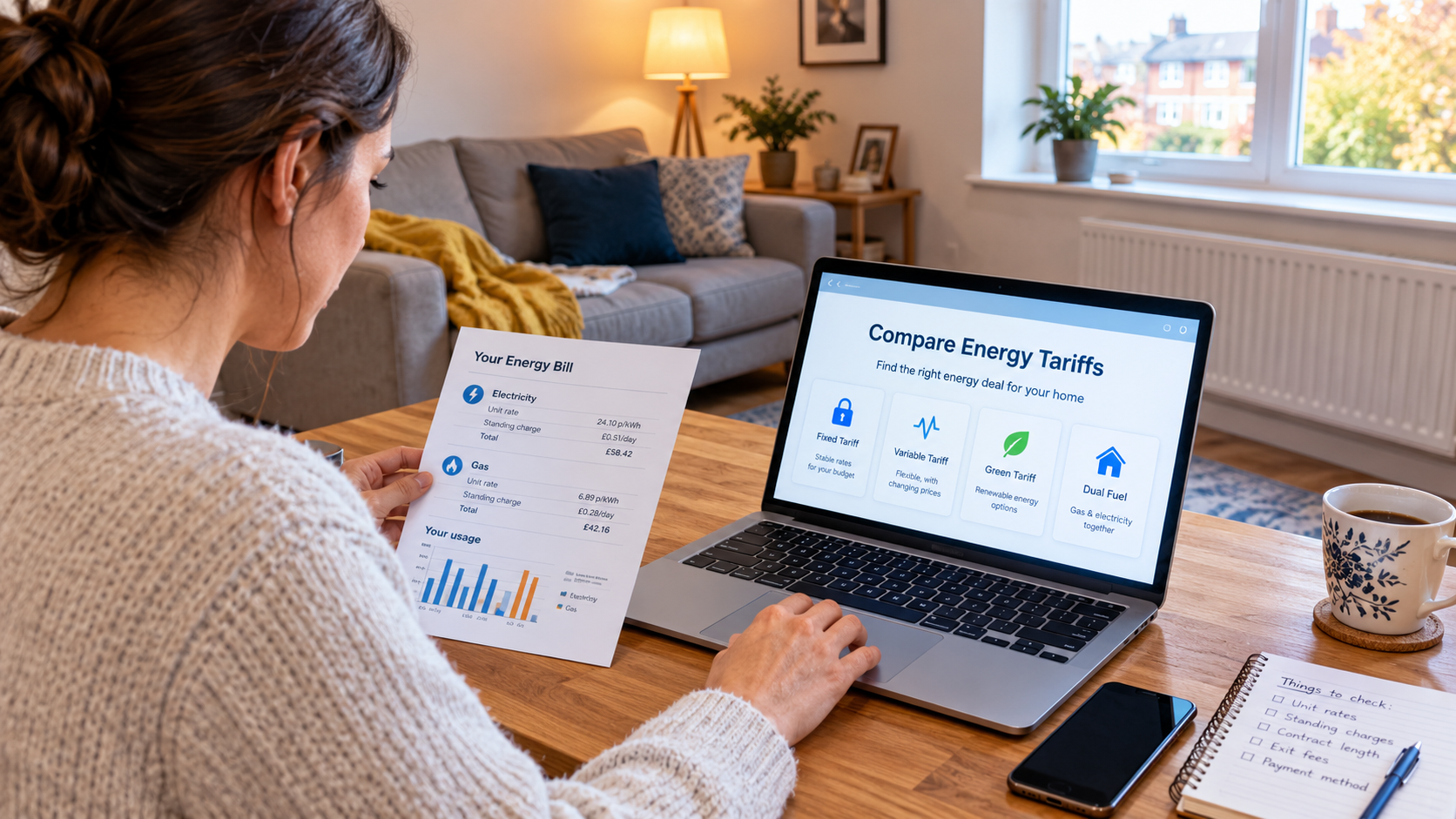
EUKnergy Tariffs Explained: How to Find a Better Deal
Rising energy costs can put pressure on any household budget, especially during the colder months when heating and lighting become more important. Choosing the right tariff can help you manage your bills, but comparing energy deals is not always straightforward. Unit rates, standing charges, contract terms and exit fees can all affect what you pay.
UK energy tariffs determine how much you pay for the gas and electricity you use. Some tariffs offer rates that remain fixed for a set period, while others change with the energy market. There are also time-of-use deals that reward households for using electricity at certain times.
The right option depends on your household’s energy consumption, location, payment method and willingness to accept changing prices. This guide explains the main tariff types, the UK energy price cap, the costs worth comparing and the practical steps you can take before switching.
What Are UK Energy Tariffs?
An energy tariff is the pricing plan your supplier uses to charge you for gas, electricity or both. It normally includes two main costs.
- Unit rate: The amount you pay for each kilowatt-hour (kWh) of energy you consume.
- Standing charge: A daily fee that helps cover the cost of supplying energy to your property, even when your consumption is low.
Your total bill depends on these charges, how much energy you use, your region, your meter and your payment arrangement.
For example, a household that uses a lot of electricity may benefit from a lower electricity unit rate. Someone who uses very little energy should pay closer attention to standing charges because these can make up a larger proportion of the bill.
This is why comparing only a supplier’s advertised monthly payment can be misleading. A monthly payment may be based on estimated consumption and can change if your actual usage differs.
Main Types of UK Energy Tariffs
Understanding the main options will make it easier to identify a deal that fits your household.
1. Fixed Energy Tariffs
A fixed tariff keeps the agreed unit rates and standing charges unchanged for the contract period, subject to the contract’s terms. Many deals last around 12 months, although other durations may be available.
Advantages
- More predictable unit rates during the contract.
- Easier household budgeting.
- Protection from increases in the agreed rates during the fixed period.
Disadvantages
- You may pay more if market prices fall.
- Early exit fees may apply when leaving a contract.
- A fixed rate does not guarantee the lowest total bill because consumption can change.
A fixed deal may suit households that value predictable costs. Before signing up, compare its estimated annual cost with the available variable tariff and check the exit conditions.
2. Standard Variable Energy Tariffs
A standard variable tariff, also called a default tariff, has rates that can change over time. In Great Britain, the Ofgem price cap limits the relevant unit rates and standing charges for covered default tariffs.
Advantages
- Usually no fixed-term commitment.
- Often greater flexibility to switch.
- You may benefit when the applicable rates fall.
Disadvantages
- Rates can rise when the cap or supplier rates change.
- Budgeting can be less predictable.
- Remaining on a default tariff without comparing alternatives may mean missing a suitable deal.
A variable tariff may be appropriate if you want flexibility or prefer not to lock in rates. However, check the available fixed deals regularly instead of assuming that your current plan is the cheapest.
3. Time-of-Use and Economy 7 Tariffs
Time-of-use tariffs charge different rates at different times. Electricity may be cheaper during designated off-peak periods and more expensive during peak hours.
Economy 7 is a familiar example, offering a lower electricity rate during a specified seven-hour off-peak period and a different rate at other times.
These tariffs can suit households that use storage heaters, charge an electric vehicle overnight or can move substantial electricity consumption to cheaper periods.
However, cheaper night-time electricity does not automatically mean lower bills. If most of your consumption occurs during expensive peak periods, a single-rate tariff could work out better.
Check the precise off-peak hours, meter requirements and both rates before choosing a time-of-use deal.
4. Green Energy Tariffs
Green tariffs are marketed around renewable electricity or other environmental attributes. Their arrangements differ between suppliers, so check what the supplier actually promises.
Review the tariff’s price, standing charges and contract conditions alongside its environmental claims. A green tariff is not necessarily more expensive, but neither is it automatically the cheapest option.
5. Dual-Fuel Tariffs
A dual-fuel tariff combines gas and electricity with one supplier, often giving you a single account and bill.
This can be convenient, but it does not guarantee the lowest price. Compare the combined cost with separate gas and electricity deals before deciding.
UK Energy Price Cap: What You Need to Know
The Ofgem energy price cap limits the unit rates and standing charges suppliers can charge on covered default tariffs in Great Britain. It is reviewed every three months.
For 1 October to 31 December 2026, Ofgem has published an average annual price-cap figure of £1,723 for a typical household using gas and electricity and paying by Direct Debit.
This is an illustrative annualised figure based on typical consumption, not a fixed annual bill or a maximum amount every household can be charged. Your actual costs depend on your usage, region, payment method and meter.
For this period, the published average Direct Debit rates are:
- Electricity: 26.32p per kWh, with a daily standing charge of 54.83p.
- Gas: 7.97p per kWh, with a daily standing charge of 29.68p.
These are averages across England, Scotland and Wales; regional rates and other payment methods can differ. The published electricity figures reflect the temporary removal of VAT from household electricity bills from 1 October 2026 to 31 March 2027. Gas continues to include 5% VAT.
Importantly, the price cap does not limit your total bill to £1,723. If you use more energy than a typical household, you can pay more. A fixed tariff is also not protected by the default-tariff price cap in the same way.
Northern Ireland has a separate energy market and is not covered by the Great Britain price cap. Northern Irish households should check their supplier’s terms and relevant local guidance.
Before making a decision, check the latest rates on Ofgem’s official website because the cap and applicable rates can change.
What Should You Compare Before Choosing an Energy Tariff?
Looking beyond the headline price can help you avoid a deal that appears cheap but costs more in practice.
Unit Rates
Compare the price per kWh for electricity and gas. Even a small difference can add up over a year when consumption is high.
Standing Charges
Standing charges apply daily, regardless of how much energy you use. Compare the combined annual standing charges for both fuels as well as the unit rates.
Estimated Annual Cost
Use your actual annual electricity and gas consumption where possible. A comparison based on your own usage is more useful than a generic monthly estimate.
Contract Length and Exit Fees
Check how long a fixed deal lasts, whether exit fees apply and when you can leave without paying them. Read the full terms rather than relying on an advertisement.
Payment Method
Rates may differ depending on whether you pay by Direct Debit, standard credit or a prepayment meter. Compare deals available for your actual payment method.
Customer Service and Billing
A low rate is not the only consideration. Review billing accuracy, meter-reading processes, complaint handling and the support available if you experience payment difficulties.
How to Compare UK Energy Tariffs Step by Step
Follow this process before switching.
- Find your current tariff. Check your latest bill or online energy account for the tariff name, unit rates and standing charges.
- Record your consumption. Use your annual electricity and gas usage in kWh rather than relying only on your monthly payment.
- Compare available deals. Use a recognised comparison service and check your existing supplier’s offers as well.
- Calculate the estimated annual cost. Include unit charges, standing charges and any applicable fees or discounts.
- Review the contract. Confirm the fixed period, exit fees, meter requirements and payment conditions.
- Check the supplier and switching arrangements. Make sure the tariff is available for your property and that the terms suit your needs.
- Keep your final details. Save the confirmation, tariff rates and switching date so you can check your first bill.
Do not switch based solely on a supplier’s estimated monthly Direct Debit. That amount is not necessarily the price of the energy you use each month.
Practical Ways to Manage Energy Costs
Changing tariffs is one option, but reducing unnecessary consumption can also help.
- Turn off lights and appliances when they are not needed.
- Use heating controls and timers to avoid heating an empty home.
- Improve draught-proofing where practical.
- Check whether your heating system is operating efficiently.
- If you have an electric vehicle or storage heating, investigate whether a suitable off-peak tariff could lower your costs.
- Submit regular meter readings if you do not have a smart meter that automatically provides readings.
- Contact your supplier early if you are struggling to pay; ask about repayment arrangements and any support you may qualify for.
The best approach is to review both the tariff and your consumption. A cheaper rate cannot fully compensate for unnecessary energy use, and reducing usage will not fix an unnecessarily expensive tariff on its own.
Comparison and Cost Table
| Tariff type | How pricing works | May suit | Main drawback |
|---|---|---|---|
| Fixed | Agreed rates stay fixed for the contract period | Households seeking predictable rates | Possible exit fees; rates may be higher than future deals |
| Standard variable | Rates can change; covered default tariffs are subject to the relevant price cap | People who value flexibility | Rates may rise |
| Time-of-use / Economy 7 | Different rates apply at different times | Households able to shift electricity use | Peak rates may be higher |
| Green | Depends on the supplier’s specific pricing and environmental arrangements | People prioritising environmental considerations | Green claims and costs need checking |
| Dual fuel | Gas and electricity supplied together | People wanting one account | Separate suppliers may offer a lower combined cost |
Illustrative Energy Cost Calculation
Suppose a household uses 2,700 kWh of electricity and 11,500 kWh of gas in a year. Using the published average Direct Debit rates for October to December 2026, its illustrative annual cost would be:
| Cost component | Calculation | Approximate cost |
|---|---|---|
| Electricity usage | 2,700 × £0.2632 | £710.64 |
| Electricity standing charge | 365 × £0.5483 | £200.13 |
| Gas usage | 11,500 × £0.0797 | £916.55 |
| Gas standing charge | 365 × £0.2968 | £108.33 |
| Illustrative total | Sum of all four items | £1,935.65 |
This is a mathematical illustration using the published average rates, not a quote or a typical-household forecast. It assumes the rates remain unchanged for the entire year, even though the published rates apply only to the October–December 2026 period. Actual costs will vary by region, tariff, usage and future price changes.
The example also shows why the £1,723 headline price-cap figure should not be treated as a household bill limit: consumption and applicable rates matter.
FAQs About UK Energy Tariffs
1. What is the best energy tariff in the UK?
There is no single best tariff for every household. Compare fixed, variable and time-of-use deals using your actual consumption, standing charges, contract terms and estimated annual cost.
2. Is a fixed energy tariff cheaper than a variable tariff?
Not always. A fixed deal may offer lower rates or more predictable costs, but it could become more expensive than a variable tariff if market prices fall. Compare current offers before committing.
3. What is the UK energy price cap in October 2026?
For 1 October to 31 December 2026, Ofgem’s published average annual price-cap figure is £1,723 for a typical dual-fuel household paying by Direct Debit in Great Britain. It is based on typical usage, not a maximum bill for every household.
4. Can I switch energy suppliers at any time?
You can generally compare and switch tariffs, but the process and any charges depend on your contract. Fixed deals may have exit fees, while switching near the end of a contract can have different conditions. Check your terms first.
5. What is a standing charge on an energy bill?
A standing charge is a daily fee for being connected to the energy network and having your supply maintained. It applies even when you use little or no energy.
6. Are green energy tariffs more expensive?
Not necessarily. Prices and environmental arrangements differ between suppliers. Compare unit rates, standing charges and the supplier’s specific renewable-energy claims before choosing.
7. Is Economy 7 worth it?
It may be worthwhile if you can use a significant amount of electricity during off-peak hours, for example with storage heaters or overnight vehicle charging. Compare the day and night rates against your actual usage pattern.
8. Does the Ofgem price cap apply across the whole UK?
No. The Ofgem domestic price cap discussed here applies to covered default tariffs in Great Britain: England, Scotland and Wales. Northern Ireland has a separate energy market.