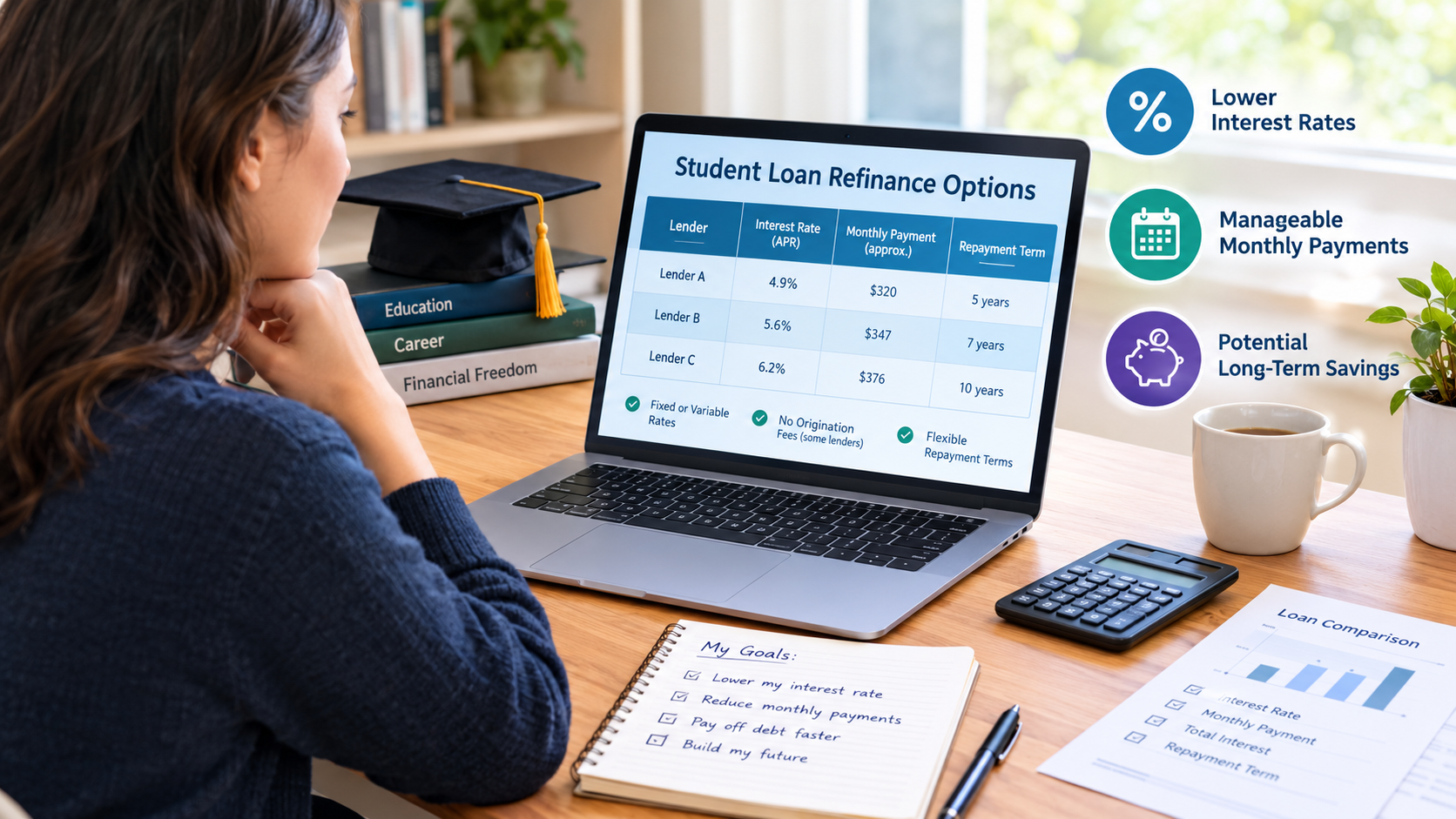
Student Loan Refinancing: How to Compare Rates and Save Money
Student loan payments can take a significant share of your monthly budget, particularly when you are starting your career, changing jobs, or managing other financial responsibilities. If your current interest rate is high, student loan refinancing may help you reduce your borrowing costs or make your payments more manageable.
However, a lower advertised rate does not automatically mean a better deal. Your credit history, income, remaining loan balance, repayment period, and existing loan protections all affect whether refinancing makes financial sense.
For borrowers in the United States, refinancing usually means replacing one or more existing education loans with a new private loan. The new lender pays off the old balances, and you make payments under the new loan agreement.
The goal is to find a loan that fits your budget while keeping total borrowing costs under control. Before applying, compare student loan rates, fees, repayment terms, and the protections you could lose.
What Is Student Loan Refinancing?
Student loan refinancing involves taking out a new loan to repay existing student debt. Depending on the lender, you may be able to refinance private student loans, eligible federal student loans, or a combination of both into a single private loan.
The new loan has its own interest rate, repayment schedule, and contractual terms. Approval and pricing generally depend on factors such as creditworthiness, income, existing debt, and the lender’s eligibility requirements.
Borrowers typically consider refinancing for three reasons:
- Lower interest costs: A more competitive rate may reduce the interest paid over the loan’s lifetime.
- Simpler repayments: Combining multiple eligible loans may leave you with one monthly payment.
- Different repayment terms: A shorter term may help you repay debt faster, while a longer term may reduce the required monthly payment.
These benefits depend on the offer you receive. Extending the repayment period can increase total interest even when the monthly payment falls.
Student Loan Refinancing vs. Federal Loan Consolidation
These terms are not interchangeable.
Federal Direct Consolidation combines eligible federal loans into a new federal Direct Consolidation Loan under government rules. It does not work like private refinancing, and the new interest rate is generally a weighted average of the interest rates on the loans being consolidated, rounded up according to federal rules.
Private refinancing replaces existing debt with a private loan. If federal loans are included, they lose their federal status and associated protections.
Borrowers should understand this distinction before choosing either option.
How Student Loan Rates Work
Student loan refinancing rates are the interest rates lenders charge borrowers for the new loan. Some lenders offer fixed rates, while others offer variable rates.
The rate you receive may differ from the lowest rate advertised on a lender’s website. Advertised minimums usually apply only to applicants who meet particular credit, income, repayment, and other eligibility criteria.
Fixed Interest Rates
A fixed-rate loan keeps the same contractual interest rate throughout the repayment period.
Potential advantages:
- Predictable interest charges.
- More stable monthly principal-and-interest payments.
- Less exposure to market-driven rate increases.
Fixed rates may suit borrowers who value predictable budgeting or expect to keep their loan for several years.
Variable Interest Rates
A variable-rate loan has an interest rate that can change according to the agreement, often in response to a benchmark rate.
Potential advantages:
- The initial rate may be lower than an available fixed-rate offer.
- Borrowers who repay quickly may benefit if rates remain favorable.
Potential disadvantages:
- Interest rates can increase.
- Monthly payments may rise, depending on the contract.
- Budgeting becomes more difficult when the rate changes.
Do not choose a variable rate solely because its starting rate looks attractive. Review how often the rate can change, any contractual caps, and the maximum payment you could reasonably afford.
What Affects Student Loan Refinancing Rates?
Lenders evaluate several factors when determining your eligibility and interest rate.
1. Credit Score and Credit History
A strong credit profile may help you qualify for more competitive rates. Lenders may also review your payment history, outstanding balances, length of credit history, and other credit information.
Before applying, review your credit reports for errors and address any outstanding issues you can reasonably resolve.
2. Income and Employment
Lenders may consider your income, employment status, and ability to meet monthly obligations. A stable income and manageable debt payments can strengthen an application, although approval criteria differ by lender.
Self-employed borrowers may need additional documentation, such as tax returns or bank statements.
3. Debt-to-Income Ratio
Your debt-to-income ratio compares your recurring monthly debt payments with your gross monthly income.
For example, if your gross monthly income is $5,000 and your monthly debt payments total $1,500, your debt-to-income ratio is 30%.
A lower ratio may help demonstrate that you can manage another financial obligation. However, lenders use different underwriting standards, and this figure alone does not guarantee approval.
4. Loan Balance and Repayment Term
The amount you want to refinance and the length of the new repayment term can affect the offers available to you.
A shorter term generally requires higher monthly payments but can reduce total interest. A longer term usually spreads payments over more months, potentially lowering the monthly amount while increasing the total cost.
5. Co-Signer and Other Eligibility Requirements
Some applicants may improve their chances of approval by applying with a qualified co-signer, where permitted by the lender.
However, a co-signer is generally responsible for the debt if the primary borrower does not pay. Review whether the lender offers a co-signer release program and what conditions apply.
How to Compare Student Loan Refinancing Offers
Comparing offers requires more than looking at the lowest advertised interest rate. Evaluate the complete loan agreement and calculate the total cost under each option.
| Comparison factor | What to check | Why it matters |
|---|---|---|
| Interest rate | Fixed or variable; actual rate offered | Determines how interest accrues |
| APR | Annual percentage rate, where provided | Helps account for interest and applicable fees |
| Repayment term | Number of months or years | Affects monthly payments and total interest |
| Origination fees | Whether the lender charges any | May increase borrowing costs |
| Monthly payment | Required payment under the offer | Helps determine affordability |
| Total repayment | Principal, interest and applicable fees | Shows the overall cost |
| Hard credit inquiry | Whether and when one occurs | Multiple applications may affect credit |
| Co-signer release | Eligibility and conditions | May offer a future path to release the co-signer |
| Financial hardship options | Deferment, forbearance and other assistance | Determines what happens if payments become difficult |
Some lenders allow you to check estimated rates through an initial eligibility process that uses a soft credit inquiry. Final approval may require a hard inquiry. Confirm the lender’s process before proceeding.
Example: Could a Lower Rate Save You Money?
Consider a hypothetical borrower with $30,000 in student loan debt and a remaining repayment term of 10 years.
Assume the borrower is comparing two fixed-rate offers with no additional fees:
| Example loan terms | Offer A | Offer B |
|---|---|---|
| Loan balance | $30,000 | $30,000 |
| Fixed annual interest rate | 8% | 6% |
| Repayment term | 10 years | 10 years |
| Approximate monthly payment | $364 | $333 |
| Approximate total payments | $43,679 | $39,966 |
| Approximate total interest | $13,679 | $9,966 |
Under these assumptions, Offer B reduces the monthly payment by approximately $31 and the total interest by about $3,713.
These figures are illustrative estimates based on standard monthly amortization, rounded to the nearest dollar. They are not live lender quotes or guaranteed savings. Actual offers may include fees, different terms, or eligibility conditions.
The example also assumes both loans have the same repayment term. Comparing loans with different terms requires checking the total amount repaid, not just the monthly payment.
Pros and Cons of Student Loan Refinancing
Refinancing can be useful when it improves the overall loan terms without sacrificing protections you need.
Pros
- Potential interest savings: A lower rate can reduce borrowing costs when the term and other fees are comparable.
- Simplified payments: Combining eligible loans can make repayment easier to manage.
- Repayment flexibility: You may be able to select a term that better suits your income and budget.
- Predictability: Switching to a fixed-rate loan may make future payments easier to plan.
- Faster debt repayment: A suitable shorter-term offer may help you clear the balance sooner.
Cons
- Loss of federal protections: Refinancing federal student loans into a private loan permanently gives up federal loan benefits associated with the refinanced balance.
- No guaranteed approval: Applicants may not qualify for a lower rate or may be offered less favorable terms.
- Potentially higher total costs: A longer term can increase the total interest paid.
- Variable-rate uncertainty: Payments or interest costs may rise under a variable-rate agreement.
- Credit and co-signer risks: Applying may involve a hard credit inquiry, and a co-signer may become liable for missed payments.
The right decision depends on the terms of your existing loans and the value of the benefits you would be giving up.