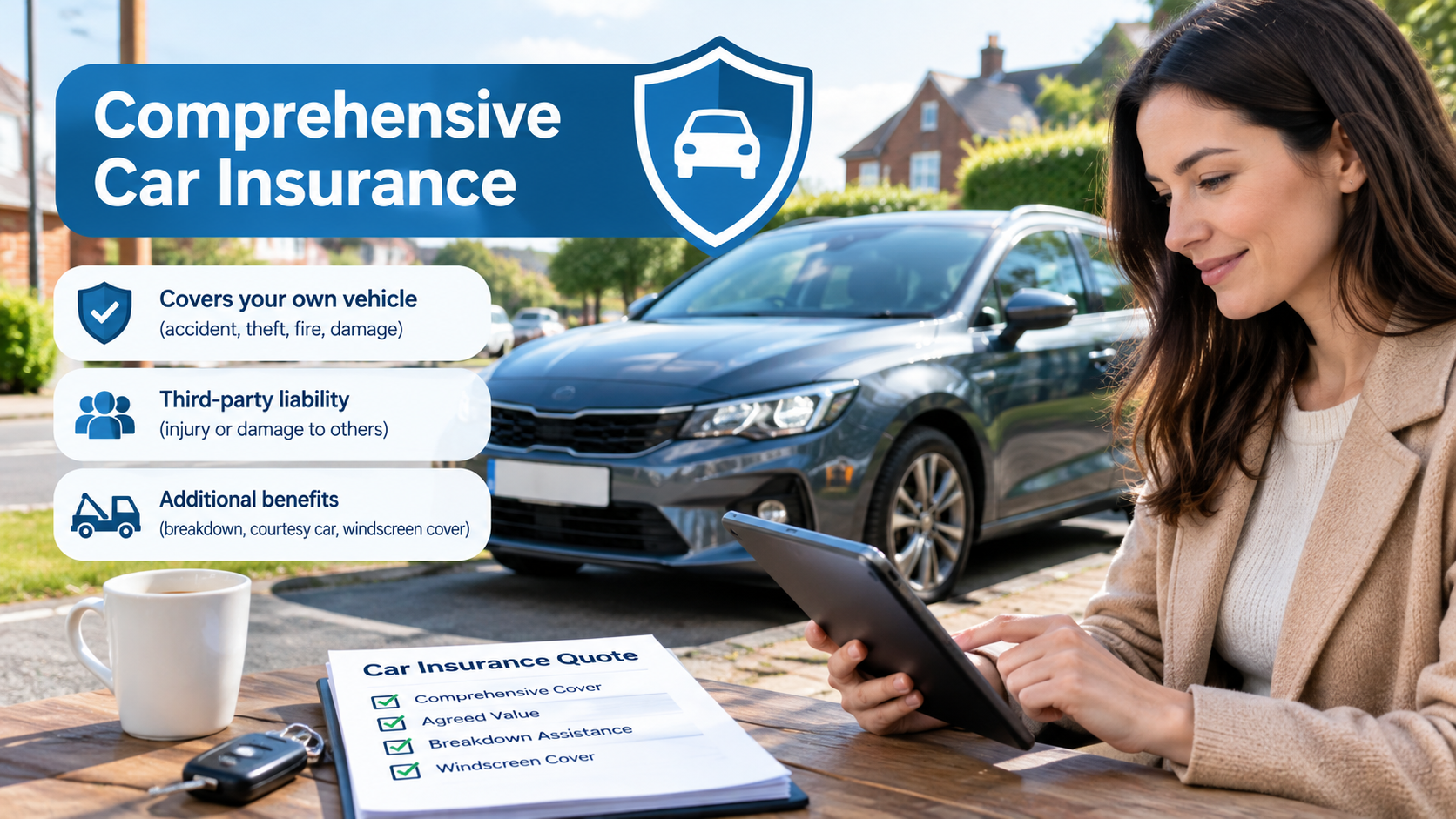
Finding the right UK car insurance is not simply about choosing the cheapest quote. A policy with a lower premium can have a higher excess, fewer benefits or important exclusions that become expensive when you need to claim.
For drivers comparing car insurance quotes UK, the better approach is to compare the overall value of each policy. That means checking the level of cover, excess, exclusions, claims process, optional extras and your own driving needs.
The latest Association of British Insurers (ABI) data available at the time of review shows that the average motor insurance premium was £560 in Q1 2026. This was £1 higher than Q4 2025 but £20 lower than Q1 2025. Individual quotes can be dramatically different because insurers assess each driver and vehicle separately.
Last updated: 8 October 2026.
What Is UK Car Insurance?
UK car insurance protects you financially against certain losses, damage and liabilities associated with driving.
You must have at least third-party insurance to drive a vehicle on UK roads. Third-party insurance covers damage or injury you cause to other people, vehicles, animals or property, but it does not normally pay to repair your own vehicle. High-Yield Savings Accounts: What to Compare
Driving without the required insurance can have serious consequences. GOV.UK states that police can issue a fixed penalty of £300 and six penalty points, while court proceedings can result in an unlimited fine and possible disqualification.
The right policy therefore needs to meet both the legal minimum and your financial needs.
Types of UK Car Insurance
There are three main levels of car insurance to compare.
1. Third-Party Insurance
Third-party cover is the legal minimum.
It generally covers your liability for injury or damage you cause to another person or their property.
It can appear attractive because you may see lower premiums, but it is not automatically the cheapest option for every driver.
2. Third-Party, Fire and Theft
This provides third-party liability protection and adds cover for situations such as:
- Your car being stolen
- Damage caused by attempted theft
- Fire damage
Your exact protection depends on the policy wording, so check exclusions and claim limits before buying.
3. Comprehensive Car Insurance
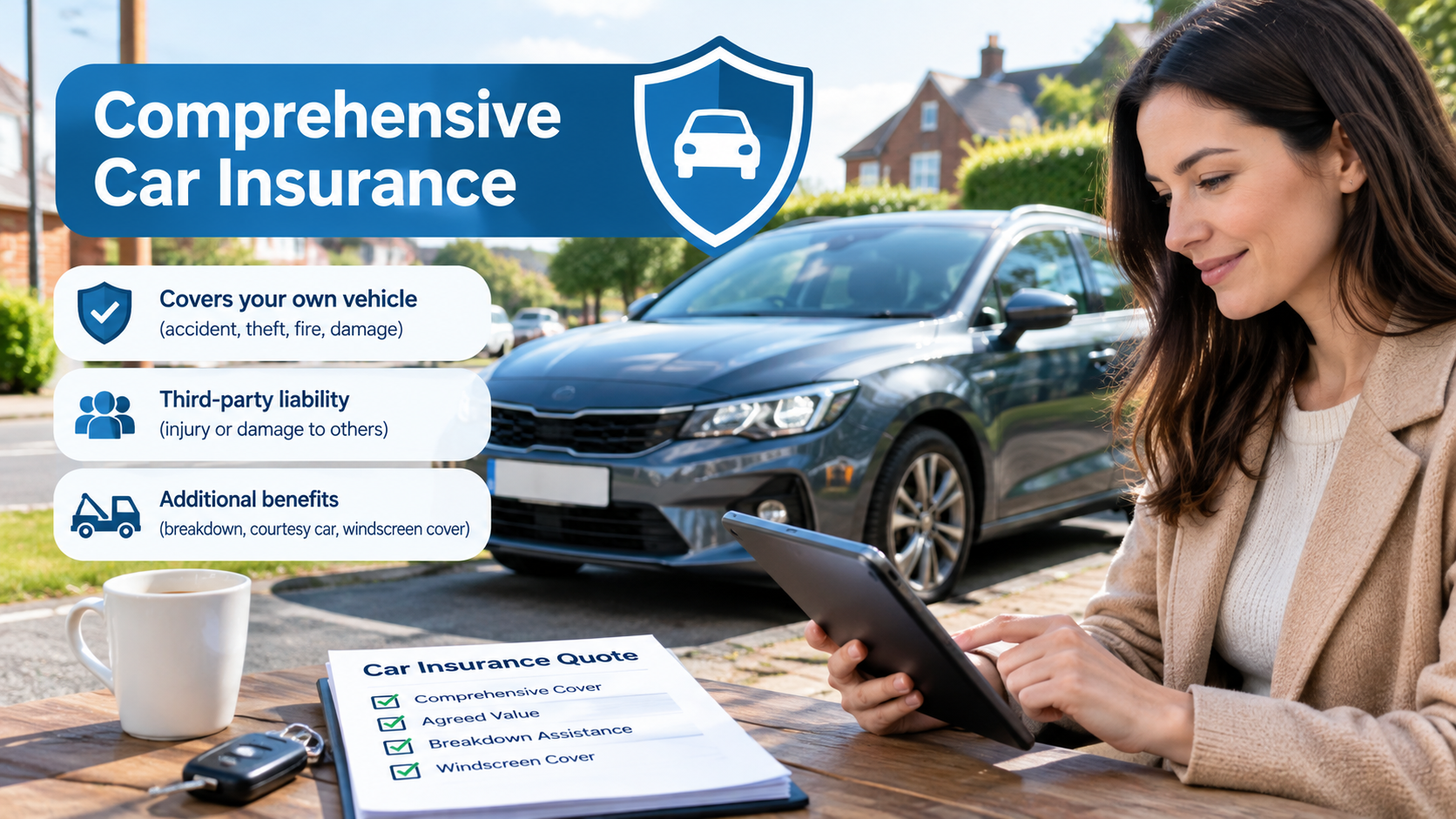
Comprehensive insurance generally provides the broadest level of cover.
It includes third-party protection and can cover damage to your own car from an insured event, subject to the policy terms and excess. Comprehensive policies may also include or offer additional benefits such as windscreen cover, courtesy cars or breakdown assistance.
Importantly, “comprehensive” does not mean every possible event is automatically covered. Always read the policy documents.
UK Car Insurance Comparison
| Cover Type | Third-Party Liability | Fire/Theft | Own-Car Accident Damage | Typical Use |
|---|---|---|---|---|
| Third party | Yes | No | No | Meeting the legal minimum |
| Third party, fire & theft | Yes | Yes | Usually no accident damage | Drivers wanting additional protection |
| Comprehensive | Yes | Yes | Generally yes, subject to terms | Drivers wanting broader protection |
MoneyHelper also recommends remembering that comparison websites show prices and product information but do not necessarily identify the policy that is most suitable for your needs.
How to Compare Car Insurance in the UK
Comparing policies properly can save money, but the cheapest headline price should not be your only consideration.
1. Decide What Level of Cover You Need
Start by deciding whether third-party, third-party fire and theft, or comprehensive cover makes sense for your circumstances.
Consider your vehicle’s value, how dependent you are on it, where you keep it and how much of a potential repair bill you could afford yourself.
2. Compare More Than One Quote
Different insurers appear on different comparison websites. MoneyHelper specifically notes that no single comparison site provides quotes from every insurer, and some major insurers do not appear on comparison sites.
A sensible comparison process can therefore include:
- One or more comparison websites
- Direct quotes from insurers
- A broker where specialist advice is useful
Don’t assume the first result is automatically the best deal.
3. Compare the Excess
The excess is the amount you agree to contribute toward an eligible claim.
There can be both:
- Compulsory excess — set by the insurer
- Voluntary excess — an additional amount you choose
For example, if your compulsory excess is £200 and your voluntary excess is £150, you could have a total excess of £350 for a claim where both apply.
A higher voluntary excess can reduce your premium, but it means you need to pay more if you make a claim. MoneyHelper recommends checking that you could actually afford the excess before choosing a higher amount.
4. Check the Policy Details
Before accepting a quote, check:
- Annual mileage
- Driving purpose
- Named drivers
- Vehicle use
- Windscreen cover
- Courtesy-car arrangements
- Breakdown cover
- Legal expenses cover
- Personal accident benefits
- Theft conditions
- Modifications
- Exclusions
A policy that costs £30 less but lacks an important benefit may not represent better value.
5. Check Your No-Claims Discount
A no-claims bonus can reduce your premium after claim-free years.
MoneyHelper says discounts can vary between insurers and can increase with additional claim-free years. It also notes that protecting a no-claims bonus does not necessarily stop your overall premium from rising after a claim.
Keep evidence of your no-claims history when changing insurer because your new provider may ask for proof.
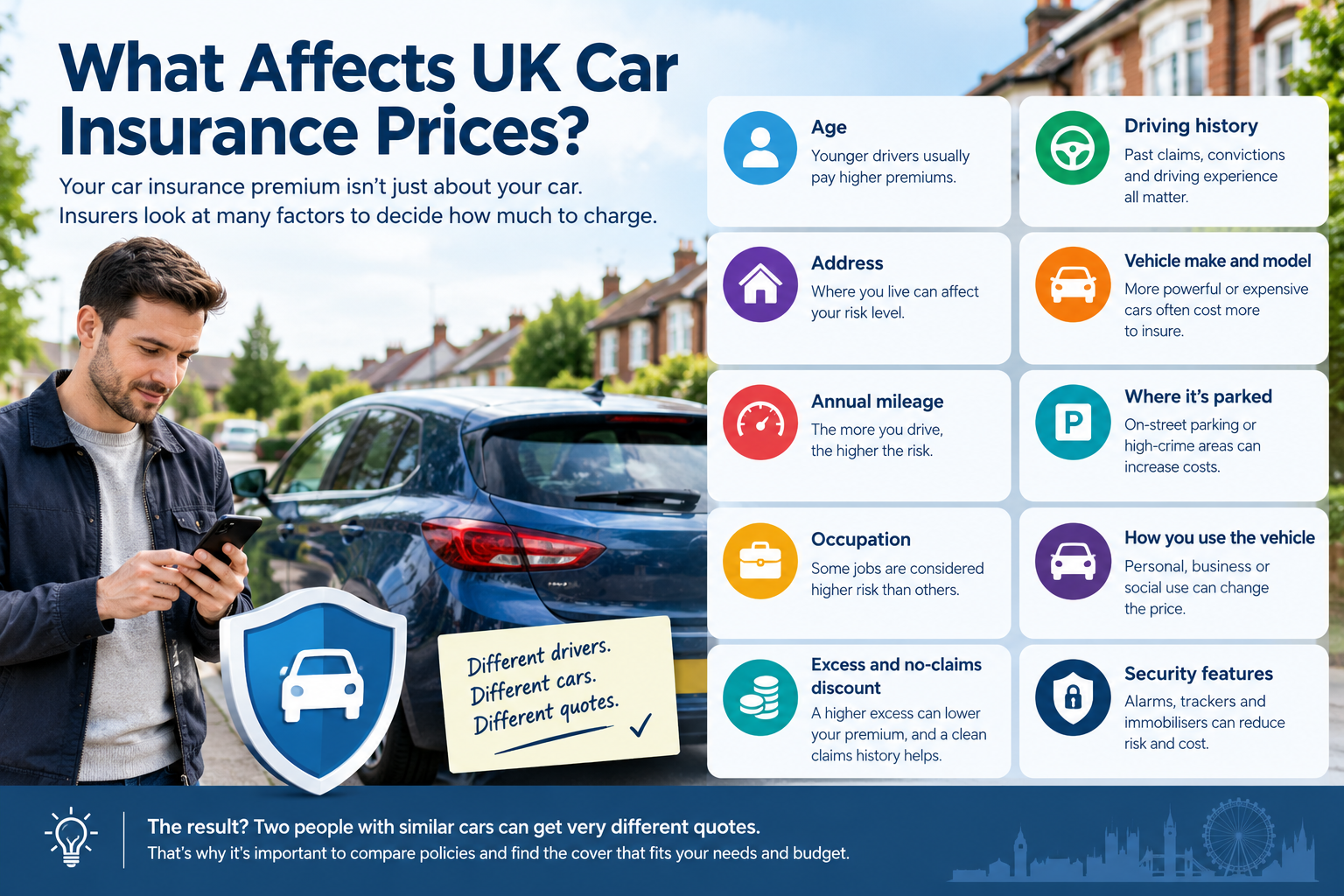
Insurers assess risk using many factors. Your quote can be affected by:
- Age
- Driving history
- Claims history
- Address
- Vehicle make and model
- Annual mileage
- Where the vehicle is parked
- Occupation
- Use of the vehicle
- Voluntary and compulsory excess
- No-claims history
- Security features
MoneyHelper identifies factors including age, address, occupation, vehicle type, mileage, parking arrangements, claims and driving convictions as factors that can affect premiums.
This is why two drivers with similar cars can receive very different quotes.
How to Reduce Car Insurance Costs
There is no guaranteed way to obtain a particular premium, but several steps can help you find better value.
Shop Around Before Renewal
Do not automatically accept your renewal price.
Use comparison sites and check insurers directly. MoneyHelper recommends comparing rather than simply accepting an automatic renewal.
Consider Your Excess Carefully
Increasing voluntary excess can reduce the premium, but only choose an amount you could comfortably pay after an accident.
Build Your No-Claims Record
A clean claims history can help reduce premiums over time. However, don’t avoid reporting an incident simply to protect a discount if your policy requires notification.
Review Optional Extras
Breakdown cover, legal expenses, courtesy-car cover and other extras can add to the cost.
Check whether you already have similar protection elsewhere before paying for it again.
Keep Your Information Accurate
Never manipulate your information to obtain a cheaper quote.
Your address, occupation, mileage, driving use and named-driver details should accurately reflect your circumstances. Incorrect information can create serious problems when you make a claim.
Is Comprehensive Car Insurance Worth It?
Comprehensive cover can make sense when repairing or replacing your vehicle would create a significant financial burden.
It can also provide broader protection than the legal minimum.
However, “comprehensive” should not be treated as a universal guarantee. Policies differ in their exclusions, excesses and additional benefits.
When comparing comprehensive policies, look beyond the premium and ask:
- What damage is covered?
- What is the total excess?
- Is a courtesy car included?
- What happens after theft?
- Are windscreen repairs covered?
- Are personal belongings covered?
- Are modifications covered?
- What exclusions apply?
What to Check Before Buying Car Insurance
Before clicking “buy”, run through this checklist:
Policy
- Correct level of cover
- Correct vehicle
- Correct registration details
- Correct driver information
Cost
- Annual premium
- Monthly payment cost, if applicable
- Compulsory excess
- Voluntary excess
- Add-on costs
Coverage
- Theft
- Fire
- Accident damage
- Windscreen
- Courtesy car
- Breakdown
- Legal expenses
Driver information
- Mileage
- Occupation
- Parking location
- Driving purpose
- No-claims discount
- Previous claims and convictions
Taking a few extra minutes can help prevent a cheap-looking policy from becoming an expensive mistake.
Comparison/Cost Table
The following figures are useful benchmarks rather than quotes for an individual driver.
| Cost Information | Latest Available Figure |
|---|---|
| Average UK motor premium, Q1 2026 | £560 |
| Change from Q4 2025 | +£1 / 0.2% |
| Change from Q1 2025 | -£20 |
| Average accidental damage claim, Q1 2026 | £3,699 |
The ABI reported that insurers paid £2.9 billion in motor claims during Q1 2026, including £1.9 billion for vehicle repairs. It also reported that the average accidental damage claim increased to £3,699.
These are market-level figures, not prices you should expect to receive. Your own car insurance quotes UK can be substantially higher or lower depending on your circumstances.
FAQs
Is car insurance legally required in the UK?
Yes. You must have at least third-party motor insurance to drive a vehicle on UK roads.
What is the cheapest type of UK car insurance?
Third-party insurance is the legal minimum, but it is not necessarily the cheapest quote available for every driver. Compare the actual premiums and cover rather than assuming a particular policy type will always cost less.
Is comprehensive car insurance better than third-party cover?
Comprehensive insurance generally provides broader protection, including cover for damage to your own vehicle under the policy terms. Whether it is better value depends on your vehicle, circumstances and the prices you are offered.
How can I get cheaper car insurance quotes in the UK?
Compare multiple insurers, review your cover, consider your excess carefully, maintain a no-claims record and check whether optional extras are genuinely useful. MoneyHelper recommends comparing several sources because comparison websites do not show every insurer.
Does a higher excess make car insurance cheaper?
It often can. A higher voluntary excess can reduce the premium, but you will have to contribute more if you make a claim. Only choose an excess you could afford.
Does a no-claims bonus reduce car insurance?
It can. Insurers commonly offer discounts for claim-free driving, although the exact discount varies between providers.
Can I use more than one comparison website?
Yes. This can be useful because different comparison sites have different insurer panels. Some insurers also sell policies directly rather than through comparison websites.
What happens if I drive without insurance?
Driving without the required insurance is illegal. GOV.UK says you could receive a £300 fixed penalty and six penalty points, with more severe penalties possible if the matter goes to court.
Conclusion
The best way to approach UK car insurance is to compare the whole policy rather than chasing the lowest headline premium.
Start with the level of cover you need, then compare premiums, excesses, exclusions and useful extras. Check your no-claims history and make sure every detail you provide to insurers is accurate.
For drivers looking for car insurance quotes UK, using more than one comparison source can broaden the range of options. But remember that the cheapest quote is not necessarily the best-value policy.
The practical next step is simple: gather your vehicle and driving details, decide what level of cover you need, compare several quotes, and read the important policy terms before buying.