Best High-Yield Savings Accounts: What to Compare Before Opening One
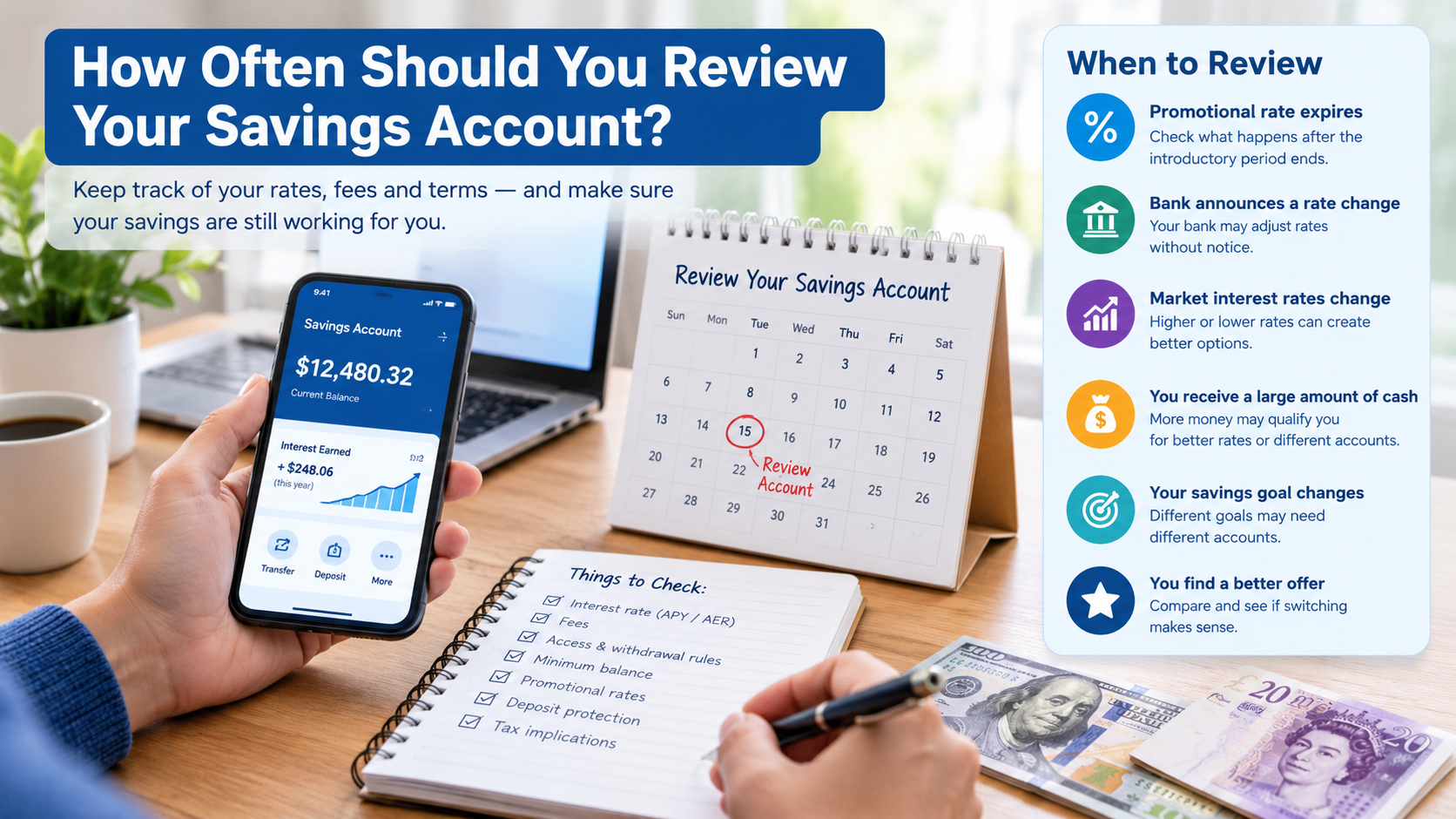
A savings account can look attractive simply because it advertises a high interest rate. But the highest advertised rate is not always the best deal.
Minimum balances, introductory rates, withdrawal rules, monthly fees, tax treatment, and deposit protection can all affect what you actually get from your savings.
For U.S. savers, a high-yield savings account can be a useful place for emergency funds, short-term goals, or cash that does not need to be invested. In the UK, similar products are usually described as easy-access or high-interest savings accounts, with AER used to make savings rates easier to compare.
The right account is therefore not necessarily the one with the biggest number. It is the one that gives you a competitive return while matching your need for access, safety, and flexibility.
Last reviewed: October 7, 2026. Rates can change frequently, so always confirm the provider’s current rate and account terms before applying.
What Is a High-Yield Savings Account?
A high-yield savings account is a deposit account designed to pay more interest than a traditional low-rate savings account.
In the United States, banks commonly advertise savings returns using APY, or Annual Percentage Yield. APY reflects the effect of compounding and is generally the number consumers should use when comparing savings accounts.
In the UK, AER, or Annual Equivalent Rate, is commonly used for the same basic comparison purpose. It shows the annual rate assuming interest is compounded according to the account’s terms.
The basic idea is simple:
More competitive rate + suitable access + low costs + appropriate protection = potentially better savings value.
However, savings rates are generally variable unless the account specifically offers a fixed rate. A rate that looks excellent today can be reduced later.
Why High-Yield Savings Accounts Matter
The difference between a low-rate account and a competitive savings account can become meaningful as your balance grows.
For example, suppose you keep $10,000 in an account earning a hypothetical 4% APY for one year, with no withdrawals or fees.
Approximate interest:
$10,000 × 4% = $400
At a hypothetical 1% APY, the same balance would produce about:
$10,000 × 1% = $100
The difference is roughly $300 over one year.
This is an illustration, not a current market-rate comparison. Actual earnings depend on the provider’s APY, compounding method, balance, rate changes, and taxes.
The same principle applies in the UK. A hypothetical £10,000 earning 4% AER would produce roughly £400 over a year if the rate remained unchanged and the money stayed in the account.
What to Compare Before Opening a High-Yield Savings Account
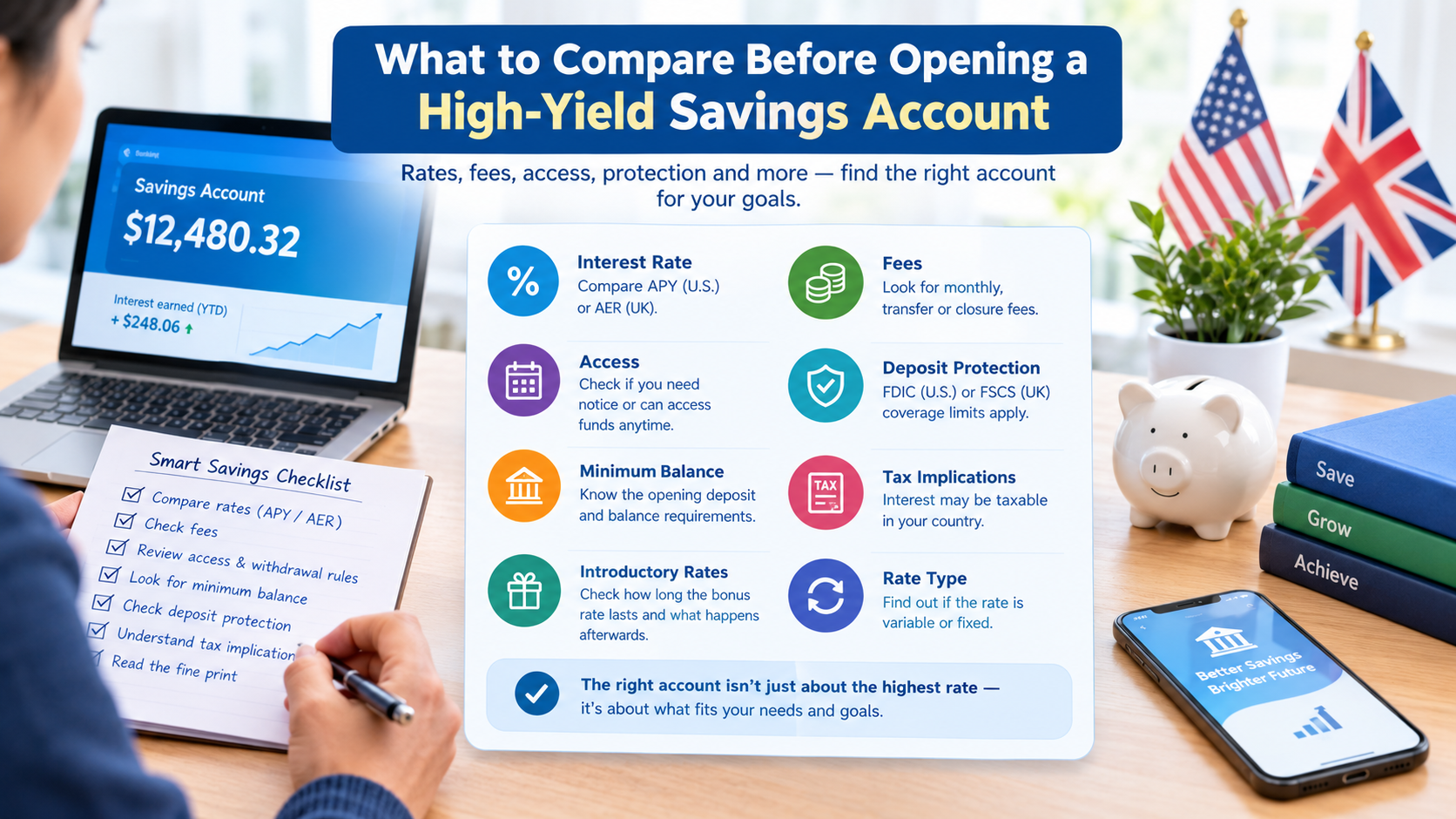
1. APY or AER
The advertised rate is usually the first thing people notice, but it should not be the only factor.
U.S. consumers should compare APYs. UK consumers should generally compare AERs.
Look beyond the headline number and ask:
- Is the rate variable or fixed?
- Is it an introductory or bonus rate?
- Does the advertised rate require a minimum balance?
- Is there a maximum balance eligible for the headline rate?
- Does the rate apply to the entire balance?
- When and how is interest paid?
- Could the rate change shortly after opening?
A slightly lower rate with no restrictions can sometimes be more useful than a higher rate with complicated conditions.
2. Minimum Opening Deposit
Some savings accounts can be opened with little or no money. Others require an initial deposit.
Check both:
- The minimum amount needed to open the account
- The minimum balance required to receive the advertised rate
These are not necessarily the same.
For example, an account could allow you to open it with $1 but require a much larger balance to receive its top APY.
3. Monthly Fees
A high interest rate becomes less attractive if the account charges a recurring fee.
Before opening an account, check whether there is:
- Monthly maintenance fee
- Excess withdrawal fee
- Paper statement fee
- Transfer fee
- Account closure fee
- Other service charges
A no-fee account is often easier to manage, particularly for emergency savings.
4. Access to Your Money
If the account is for an emergency fund, you may want easy access. If you are saving for a goal several years away, you may be willing to accept more restrictions in exchange for a higher return.
Compare:
| Feature | Easy/Instant Access | Notice or Fixed Account |
|---|---|---|
| Access | Usually quick | May require notice |
| Rate | Often competitive | Can sometimes be higher |
| Flexibility | High | Lower |
| Emergency fund suitability | Usually better | Often less suitable |
| Withdrawal restrictions | Usually fewer | More likely |
UK savings products can have notice periods or withdrawal limits, while U.S. accounts can also have provider-specific transfer and withdrawal rules.
Always read the current account agreement rather than assuming all savings accounts work the same way.
5. Introductory and Bonus Rates
Some accounts advertise a special rate for a limited period.
A bonus can be useful, but calculate what happens after the promotional period ends.
Ask:
What rate will I receive after the bonus expires?
If the ongoing rate is significantly lower, you may need to review the account again later.
6. Deposit Protection
Safety should be part of your comparison.
For U.S. consumers, eligible deposits at an FDIC-insured bank are generally insured up to $250,000 per depositor, per insured bank, per ownership category.
For UK consumers, eligible deposits with an authorised bank, building society, or credit union are generally protected by the FSCS up to £120,000 per eligible person, per authorised firm. The UK limit increased from £85,000 to £120,000 on December 1, 2025.
This protection is important, especially if you have a large cash balance.
Remember that protection limits apply according to the relevant legal and banking structure. Two different brand names do not necessarily mean two separate protection limits if they operate under the same banking licence or authorised firm.
7. Taxes on Interest
The interest you earn may have tax consequences.
In the U.S., interest from ordinary savings accounts is generally taxable income unless a specific exception applies.
In the UK, savings interest can be affected by the Personal Savings Allowance and other tax rules.
For the 2026/27 UK tax year, the Personal Savings Allowance is:
- £1,000 for basic-rate taxpayers
- £500 for higher-rate taxpayers
- £0 for additional-rate taxpayers
Other UK savings rules can also apply, including the starting rate for savings.
Your personal tax position can be more complicated if you have multiple income sources or different types of savings products. When in doubt, check current HMRC guidance or obtain professional tax advice.
High-Yield Savings Account Comparison
| Factor | What to Look For | Why It Matters |
|---|---|---|
| Interest rate | APY in the U.S.; AER in the UK | Determines potential return |
| Rate type | Variable or fixed | Variable rates can change |
| Minimum balance | Opening and rate requirements | May affect eligibility |
| Fees | Monthly and transaction fees | Can reduce your return |
| Access | Instant, easy, notice or fixed | Determines flexibility |
| Withdrawals | Limits or penalties | Important for emergency funds |
| Intro rate | Promotional period and expiry | Rate may fall later |
| Deposit protection | FDIC or FSCS eligibility | Helps protect eligible deposits |
| Tax | Local savings-interest rules | Affects after-tax return |
| Provider | Bank/authorised institution | Important for safety and service |
Pros and Cons of High-Yield Savings Accounts
Pros
- Can earn more interest than many basic savings accounts.
- Usually lower risk than investing in stocks or other market-based assets.
- Useful for emergency funds and short-term goals.
- Money can remain accessible with many easy-access accounts.
- FDIC or FSCS protection may apply when eligibility requirements are met.
- Easy to compare using APY or AER.
Cons
- Interest rates can fall.
- The highest rate may require conditions.
- Promotional rates may expire.
- Some accounts restrict withdrawals.
- Interest may be taxable.
- Inflation can reduce the real purchasing power of your savings.
- A high advertised rate does not automatically mean the account is suitable for you.
High-Yield Savings vs. Other Savings Options
A high-yield savings account is not the only place to keep cash.
High-Yield Savings Account
Best for people who want a combination of interest and relatively easy access.
Fixed-Term Savings or CDs
These can offer predictable returns for a defined period, but access may be restricted or early withdrawal may involve penalties.
Money Market Deposit Accounts
In the U.S., money market deposit accounts are bank deposit products that can have different features from ordinary savings accounts. They should be compared based on their specific terms rather than assuming they are automatically better.
Cash ISAs
For UK savers, a Cash ISA can provide tax-free interest within the applicable ISA rules and annual allowance.
The right option depends on your tax position, access requirements, balance, and savings goal.
How Much Difference Can the Rate Make?
Consider a hypothetical $25,000 balance.
At 4% APY, ignoring compounding for a simple illustration:
$25,000 × 4% = $1,000
At 2%:
$25,000 × 2% = $500
That is a $500 difference over a year before considering taxes, fees, and changes in the rate.
This demonstrates why comparing savings rates can matter more as your balance increases.
However, do not choose an account based on rate alone. Losing convenient access to emergency money or paying fees could outweigh part of the extra interest.
How to Choose the Right Account for Your Goal
For an Emergency Fund
Prioritise:
- Easy access
- No or low fees
- Competitive variable rate
- Deposit protection
- Reliable online or mobile access
Your emergency fund is not just about earning interest. It needs to be available when an unexpected expense appears.
For a Short-Term Purchase
If you are saving for a holiday, vehicle, home deposit, or another planned expense, compare the expected timing of the expense with the account’s access rules.
A slightly higher return may not be worthwhile if you need to give several weeks’ notice to withdraw your money.
For Cash You Will Not Need Soon
You may want to compare high-yield savings accounts with fixed-term products.
The key question is:
How much flexibility am I willing to give up for a potentially higher or more predictable return?
A Simple Checklist Before Opening an Account
Before clicking “Open Account,” check these points:
-
Current APY or AER
-
Whether the rate is variable
-
Promotional-rate expiry date
-
Minimum opening deposit
-
Minimum balance requirements
-
Monthly fees
-
Withdrawal restrictions
-
Transfer rules
-
Interest payment frequency
-
FDIC or FSCS protection
-
Tax implications
-
What happens if the rate changes
This takes only a few minutes but can prevent unpleasant surprises later.
How Often Should You Review Your Savings Account?
Savings rates change.
UK MoneyHelper specifically recommends regularly checking whether you are still receiving a competitive savings rate. The top rate can change frequently as providers adjust their offers.
U.S. savers should take a similar approach, particularly when their account has a variable rate.
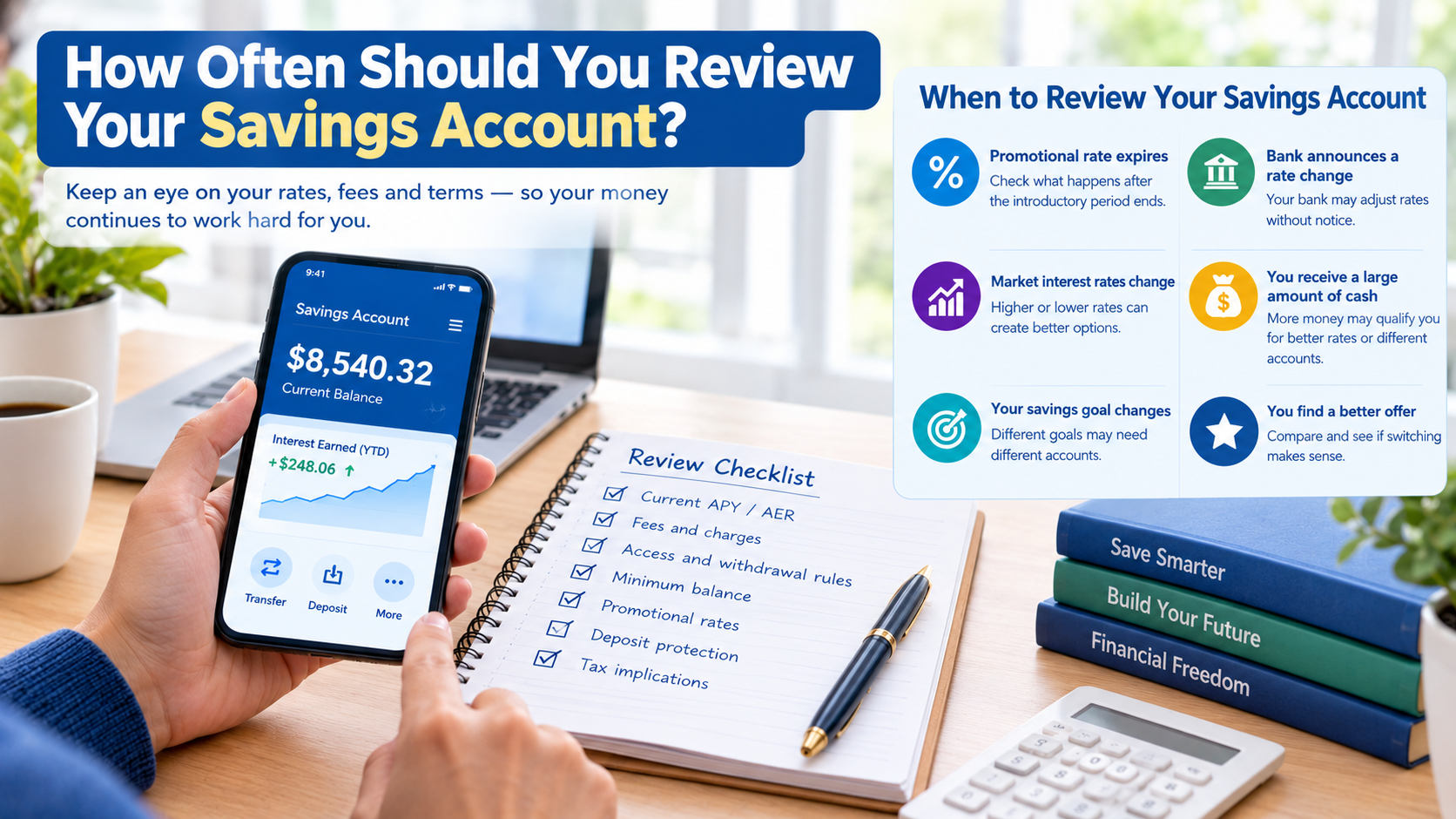
A simple habit is to review your savings account when:
- Your promotional rate expires
- Your bank announces a rate change
- Market interest rates change significantly
- You receive a large amount of cash
- Your savings goal changes
- You notice another suitable account offering materially better terms
You do not necessarily need to switch every time another account pays slightly more. The extra interest should be weighed against the effort, restrictions, and any risks associated with moving your money.
Author/Expertise Note
This article provides general financial education, not personalised financial or tax advice. Because savings rates, tax rules, and account terms can change, readers should verify current details directly with the relevant bank, regulator, or tax authority before opening an account.
For publication on BUYzir.com, financial content should receive appropriate editorial and subject-matter review before publication.
Comparison/Cost Table
| Cost or Return Factor | U.S. High-Yield Savings | UK Easy-Access Savings |
|---|---|---|
| Main comparison rate | APY | AER |
| Typical rate structure | Often variable | Often variable |
| Monthly fee | Depends on provider | Depends on provider |
| Minimum balance | Depends on provider | Depends on provider |
| Deposit protection | FDIC eligibility | FSCS eligibility |
| Standard protection limit | $250,000 per depositor, per insured bank, per ownership category | £120,000 per eligible person, per authorised firm |
| Interest tax | Generally taxable interest | Personal Savings Allowance and other UK tax rules may apply |
| Best use | Emergency fund and short-term cash | Emergency fund and short-term cash |
Important: The rates in this table are deliberately not presented as current “best rates.” Savings rates change frequently, so BUYzir should verify provider-specific rates immediately before publishing any rate-based comparison.
FAQs
1. What is a high-yield savings account?
A high-yield savings account is a deposit account designed to pay a relatively competitive interest rate. In the U.S., savings returns are commonly compared using APY. UK consumers generally compare savings products using AER.
2. Is a high-yield savings account safe?
It can be, provided the account is offered by an appropriately protected deposit-taking institution and your money falls within the applicable protection rules. In the U.S., FDIC insurance generally covers eligible deposits up to $250,000 per depositor, per insured bank, per ownership category. In the UK, FSCS protection generally covers eligible deposits up to £120,000 per person, per authorised firm.
3. Can the interest rate on a high-yield savings account change?
Yes. Many savings accounts have variable rates. The provider can change the rate according to the account’s terms. Always check whether an advertised rate is fixed, variable, or promotional.
4. Are high-yield savings accounts taxable?
Interest can be taxable. U.S. savings-account interest is generally taxable income. UK savers may have a Personal Savings Allowance and other rules that determine how much savings interest is taxable.
5. How much money should I keep in a high-yield savings account?
There is no single correct amount. Many people use savings accounts for emergency funds and short-term goals. The appropriate amount depends on income stability, monthly expenses, upcoming costs, debt, and personal circumstances.
6. Is a higher savings rate always better?
No. A higher rate can be attractive, but withdrawal restrictions, minimum balances, fees, promotional periods, and deposit protection can make another account more suitable.
7. Should I move my savings when another bank offers a higher rate?
Not automatically. Compare the complete terms and calculate how much extra interest you would actually earn. If the difference is small, convenience and flexibility may be more valuable.
8. What is the difference between APY and AER?
APY is commonly used in the U.S. and AER is commonly used in the UK. Both are designed to make annual savings returns easier to compare while accounting for the effect of compounding under the relevant product terms.
Conclusion
The best high-yield savings account is not necessarily the account with the highest number in an advertisement.
Before opening one, compare the APY or AER, minimum balance, fees, access rules, withdrawal restrictions, promotional period, tax treatment, and deposit protection.
For U.S. savers, check FDIC insurance. For UK savers, check FSCS protection and the authorised firm behind the account.
Most importantly, choose the account based on what the money is for. An emergency fund needs accessibility. Money you will not need for a fixed period may be better suited to a different savings product.
A competitive rate matters, but a competitive rate on an account that actually fits your needs matters more.