Personal loan rates can vary widely depending on the lender, borrower, loan amount, repayment term, and financial profile. Even if you have good credit, you are not automatically guaranteed the lowest rate. Lenders may also consider your income, existing debts, credit history, and ability to repay the loan.
That is why comparing the advertised interest rate alone can be misleading. The APR, fees, monthly payment, repayment term, and total amount repaid can all affect the real cost of borrowing.
Whether you are comparing personal loans in the United States or the United Kingdom, understanding personal loan rates and the costs behind them can help you make a more informed borrowing decision.
What Is a Personal Loan?
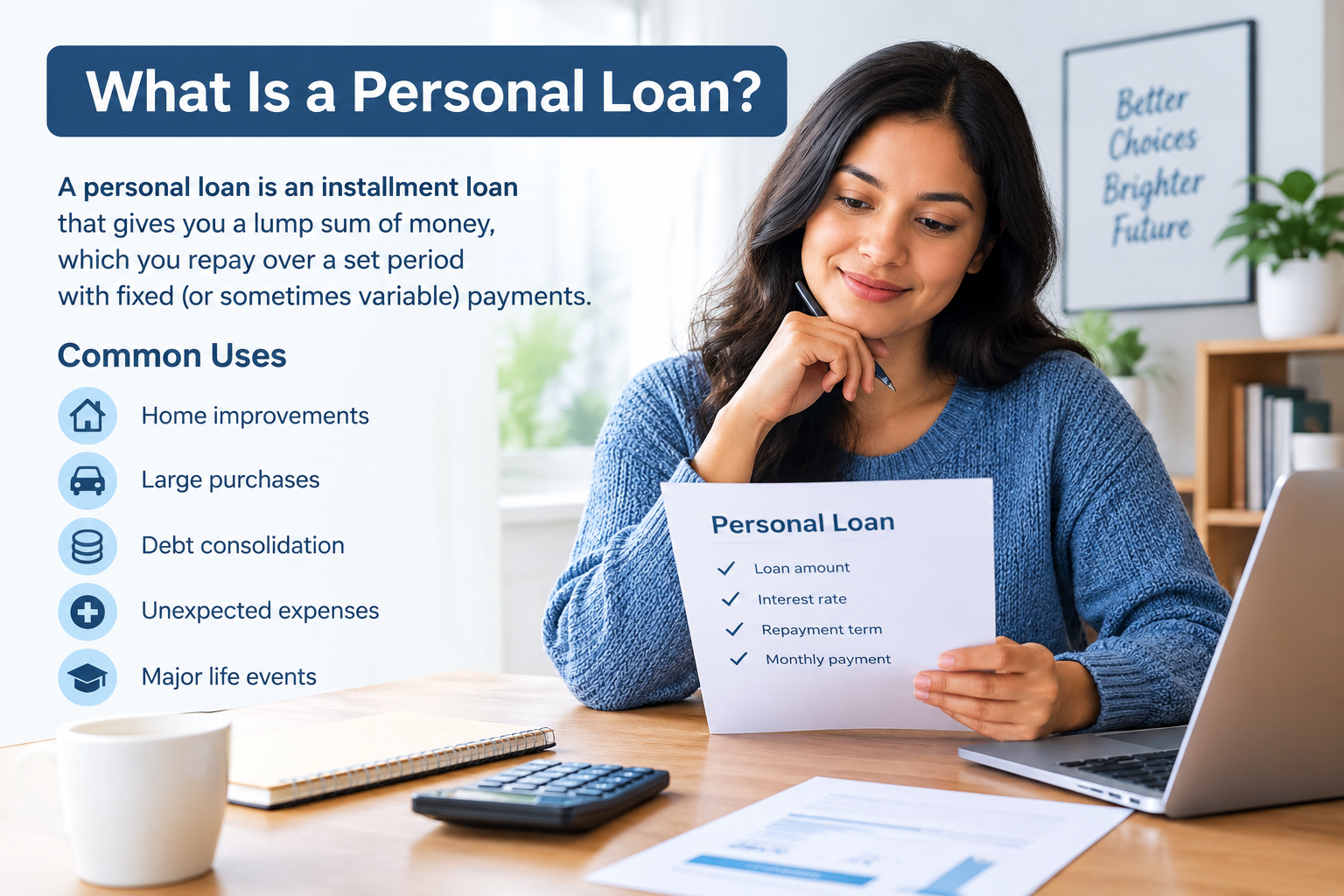
A personal loan is usually an unsecured installment loan. You receive a lump sum and repay it through scheduled payments over an agreed period. The Consumer Financial Protection Bureau’s guide to personal installment loans explains that personal installment loans can be used for purposes such as large purchases, unexpected expenses, and debt consolidation.
Personal loans may be used for:
- Debt consolidation
- Home improvements
- Large purchases
- Unexpected expenses
- Major life expenses
- Other permitted personal needs
The exact permitted uses vary by lender.
Unlike a credit card, a personal installment loan normally has a defined loan amount, repayment period, and payment schedule. Lenders may consider your credit score, income, debts, loan amount, and loan term when determining the interest rate and terms.
How Personal Loan Rates Are Determined
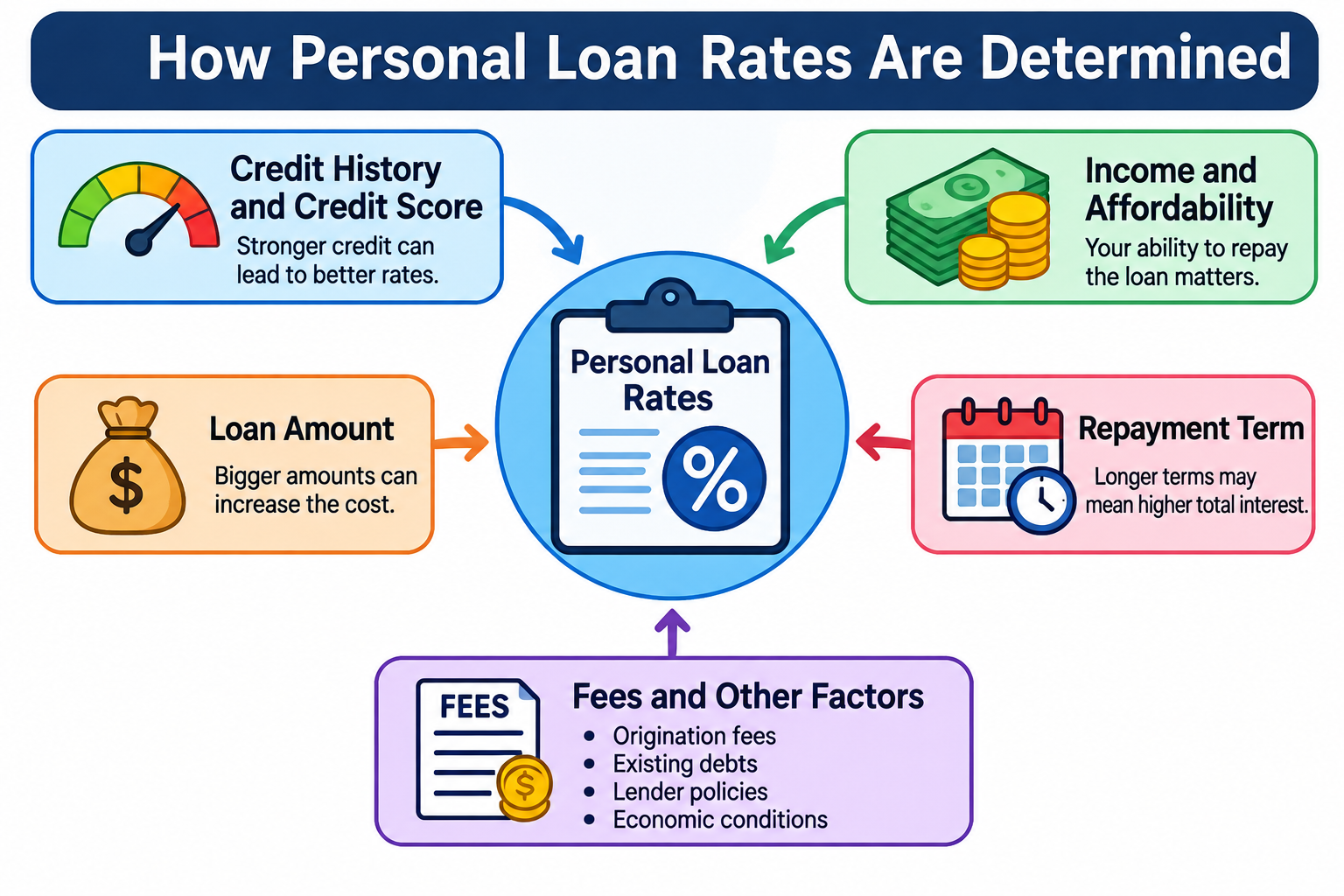
There is no single personal loan rate available to everyone.
Two people applying for the same amount from the same lender could receive different offers. Several factors can affect personal loan rates.
Credit History and Credit Score
Your credit profile is one of the factors lenders may use when evaluating a personal loan application. Generally, stronger credit can help borrowers qualify for more competitive rates, although a good credit score does not guarantee approval or a specific rate.
This is especially important when looking at advertised personal loan rates. An advertised rate may be a starting or representative rate rather than the rate you personally receive.
Income and Affordability
Lenders also need to determine whether you can reasonably handle the new payment.
Your income, existing debts, and other financial commitments can affect the lender’s assessment. A borrower with excellent credit may still receive different terms from another borrower because their income and debt levels are different.
Loan Amount
The amount you borrow can affect both your monthly payment and total borrowing cost.
Borrowing more can increase the amount of interest you pay, even when the interest rate remains the same.
The right loan amount is therefore not necessarily the maximum amount a lender offers. Borrow only what you actually need and can comfortably repay.
Repayment Term
A longer loan term can reduce the required monthly payment, but it can increase the total interest paid.
For example, consider an illustrative $20,000 loan with no fees:
| Example Rate | Term | Approx. Monthly Payment | Approx. Total Interest |
|---|---|---|---|
| 8% | 36 months | $626.73 | $2,562 |
| 12% | 36 months | $664.29 | $3,914 |
| 18% | 36 months | $723.05 | $6,030 |
These are mathematical examples, not current lender offers. They show why differences in personal loan rates can make a meaningful difference to the cost of borrowing.
Personal Loan Rates: What Should You Compare?
The lowest advertised interest rate is not necessarily the cheapest loan.
When comparing personal loan rates, look at the complete cost of each offer.
1. APR
APR is one of the most useful figures for comparing borrowing costs. The CFPB explanation of interest rate vs. APR explains that APR can reflect the interest rate plus certain additional loan fees.
Compare APR with APR rather than comparing an interest rate from one lender against an APR from another.
2. Interest Rate
The interest rate determines the interest charged on the outstanding loan balance.
A lender may advertise a lower interest rate than another lender but charge fees that make the overall borrowing cost higher.
That is why the interest rate should be considered alongside APR and total repayment when comparing personal loan rates.
3. Origination and Other Fees
Some personal loans include an origination fee or other charges.
The CFPB guide to personal installment loan fees notes that potential charges can include origination fees, documentation fees, and late fees.
Before accepting a loan, ask:
- Is there an origination fee?
- Is it deducted from the money you receive?
- Are there application or documentation fees?
- What is the late-payment fee?
- Is there a prepayment penalty?
- Are optional insurance products being added?
4. Total Amount Repaid
The total amount repaid may be more useful than focusing on the monthly payment alone.
A loan with a lower monthly payment can cost more overall if it has a longer repayment term.
Before signing, check the total amount you will repay under the proposed terms.
5. Monthly Payment
The payment needs to fit comfortably into your budget.
Do not choose a loan simply because its monthly payment looks affordable. Check the payment against your other debts, household expenses, and savings goals.
6. Repayment Term
Compare the same loan amount over different terms.
For example, a 24-month loan and a 60-month loan can have very different monthly payments and total interest costs.
A shorter term may mean higher monthly payments but less interest overall.
7. Fixed Versus Variable Rate
Check whether the interest rate is fixed for the entire loan.
A fixed-rate loan generally gives you a predictable scheduled payment. If a loan has a variable rate, understand when and how the rate can change.
Do not assume every personal loan has identical rate structures.
Personal Loan Rates for Good Credit: Does Good Credit Guarantee a Low Rate?
Good credit can improve your chances of receiving competitive personal loan rates, but it does not guarantee the lowest rate.
A lender may look at:
- Credit history
- Credit score
- Income
- Existing debt
- Loan amount
- Repayment term
- Employment or financial information
- Other risk factors
A strong credit score is helpful, but lenders can still consider the rest of your financial profile.
If you have good credit, use it as a reason to compare offers rather than as a reason to accept the first offer you receive.
How to Compare Personal Loan Rates
A simple comparison process can help prevent expensive mistakes.
Step 1: Decide How Much You Actually Need
Start with the amount required for the specific purpose.
Avoid borrowing extra money simply because the lender approves a larger amount.
Step 2: Check Your Credit Information
U.S. borrowers can check their credit reports before applying. The official AnnualCreditReport.com website is the authorized source for free credit reports from the nationwide credit reporting companies.
Reviewing your information before applying can help you identify errors or unexpected accounts.
UK borrowers can also obtain statutory credit reports from the main credit reference agencies.
Step 3: Compare Multiple Lenders
Check banks, credit unions, and reputable online lenders where appropriate.
Do not assume your existing bank automatically offers the cheapest loan.
Different lenders may offer different personal loan rates based on their own underwriting criteria.
Step 4: Check Eligibility Options First
Some lenders and comparison services offer eligibility checks that may use a soft search.
These checks can help you understand whether you may qualify before submitting a full application. Always check the lender’s terms to understand whether the search is soft or hard.
Step 5: Compare Like-for-Like Offers
Use the same:
- Loan amount
- Repayment term
- Currency
- Rate type
- Fee assumptions
Then compare APR and total repayment.
Step 6: Read the Final Loan Agreement
An advertised rate is not the same as a final approved offer.
Review the actual agreement before accepting the loan. Confirm the final rate, APR, fees, repayment schedule, and total amount you will repay.
Pros and Cons of Personal Loans
Pros
- Fixed repayment schedules can make budgeting easier.
- Interest rates may be lower than some forms of high-cost revolving credit.
- You can borrow a defined amount rather than repeatedly using a credit line.
- A shorter repayment term can help you pay off debt faster.
- Competitive borrowers may qualify for better terms.
Cons
- Interest increases the total cost of borrowing.
- Fees can raise the effective cost.
- A longer term can result in more interest paid.
- Missed payments can damage your credit history.
- Taking on unnecessary debt can put pressure on your monthly budget.
U.S. vs. UK Personal Loan Rates
Personal loans work similarly in broad terms, but the rules and terminology are not identical.
| Factor | United States | United Kingdom |
|---|---|---|
| Common comparison measure | APR | APR |
| Rate depends on credit profile | Yes | Yes |
| Income and debt can matter | Yes | Yes |
| Fees can affect cost | Yes | Yes |
| Good credit guarantees approval? | No | No |
| Regulatory authority highlighted | CFPB / federal framework | FCA |
In the UK, the Financial Conduct Authority’s APR guidance explains that APR indicates the yearly cost of borrowing, including interest and fees. The FCA also distinguishes representative APR from the rate an individual borrower will necessarily receive.
UK borrowers should therefore pay attention to representative APR disclosures and total repayment information when comparing personal loan rates.
When a Personal Loan May Make Sense
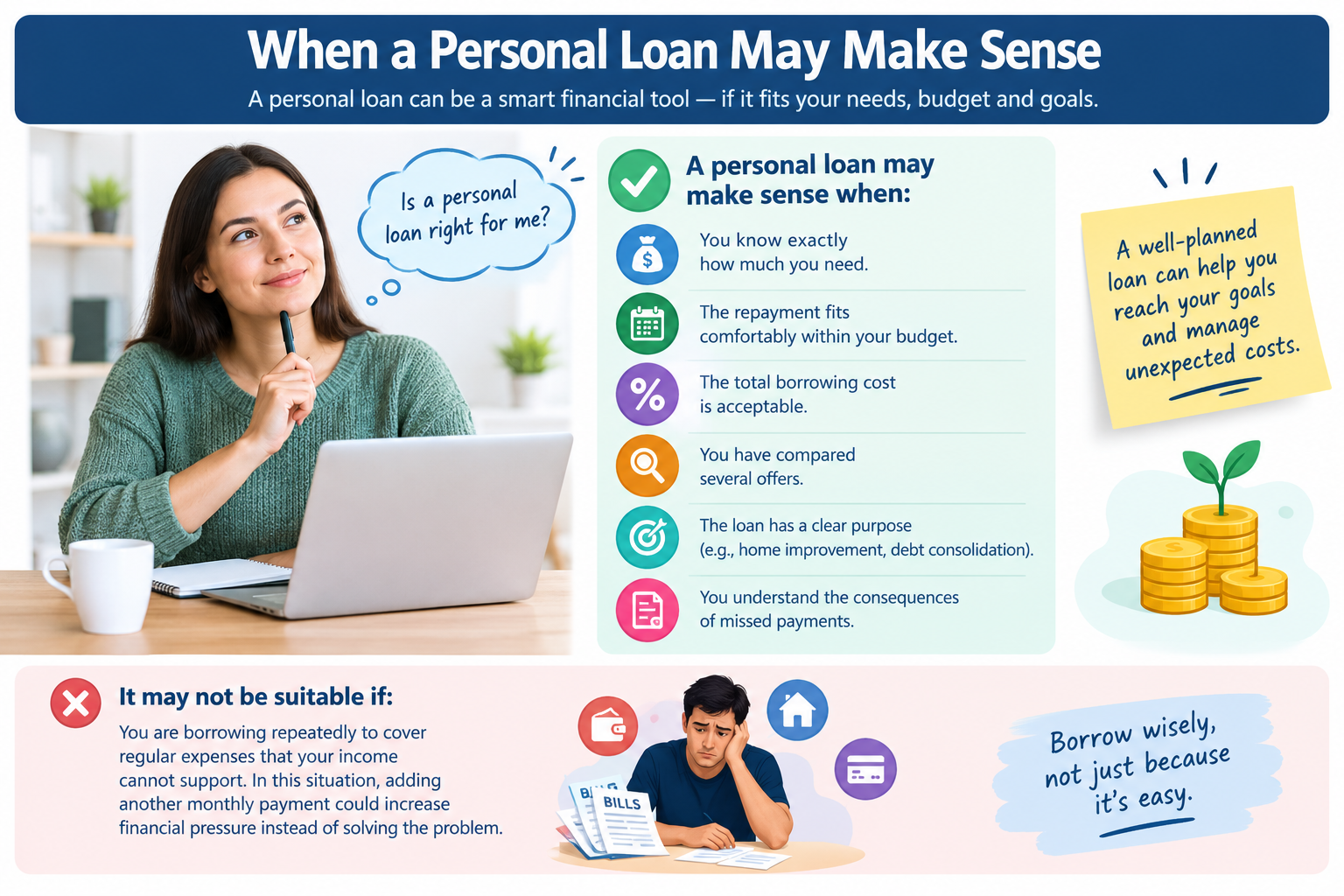
A personal loan can be reasonable when:
- You know exactly how much you need.
- The repayment fits comfortably within your budget.
- The total borrowing cost is acceptable.
- You have compared several offers.
- The loan has a clear purpose.
- You understand the consequences of missing payments.
It may be less suitable if you are borrowing to cover recurring expenses that your regular income cannot support.
In that situation, adding another monthly payment can make the underlying financial problem worse.
How to Potentially Get Better Personal Loan Rates
If you have time before applying, consider:
- Reviewing your credit reports for errors.
- Reducing unnecessary existing debt where practical.
- Comparing several lenders.
- Using eligibility checks when available.
- Choosing an appropriate loan amount.
- Comparing shorter and longer repayment terms.
- Checking fees as carefully as the interest rate.
- Avoiding unnecessary applications.
The goal should not simply be to find the lowest advertised percentage.
The better goal is to find a loan with a competitive APR, manageable payment, reasonable fees, and an appropriate repayment period.
Personal Loan Comparison Table
For a practical comparison, create a worksheet like this before choosing a loan:
| Feature | Offer A | Offer B | Offer C |
|---|---|---|---|
| Loan amount | $20,000 | $20,000 | $20,000 |
| APR | Check offer | Check offer | Check offer |
| Interest rate | Check offer | Check offer | Check offer |
| Origination fee | Check offer | Check offer | Check offer |
| Term | 36 months | 48 months | 60 months |
| Monthly payment | Check offer | Check offer | Check offer |
| Total repayment | Check offer | Check offer | Check offer |
| Prepayment penalty | Check offer | Check offer | Check offer |
| Late fee | Check offer | Check offer | Check offer |
Tip: Never fill this table with advertised figures unless they have been verified for the exact borrower, loan amount, and date. Loan offers can change based on individual circumstances.
FAQs About Personal Loan Rates
1. What are personal loan rates for good credit?
Borrowers with stronger credit profiles may qualify for lower personal loan rates, but there is no single rate guaranteed to everyone with good credit. Lenders can also consider income, debts, loan amount, and repayment term.
2. Is APR more important than the interest rate?
For comparing overall borrowing costs, APR can be more informative because it can include the interest rate and certain fees. However, you should also review the total repayment and actual loan agreement.
3. Does a good credit score guarantee personal loan approval?
No. A good credit score can strengthen an application, but lenders can consider affordability, income, existing debt, and other information before approving a loan.
4. Are personal loans cheaper than credit cards?
Not automatically. The answer depends on the interest rate, fees, repayment period, and specific credit-card terms. Compare the actual APR and total cost rather than assuming one product is always cheaper.
5. Can personal loan rates change?
It depends on the loan. Some loans have fixed rates while others may have variable-rate structures. Always check the agreement to understand whether your rate and payment can change.
6. What fees should I check before taking a personal loan?
Look for origination or arrangement fees, documentation charges, late-payment fees, and any prepayment charges. The CFPB recommends reviewing loan disclosures and documents for applicable fees before agreeing to a personal installment loan.
7. Should I choose the loan with the lowest monthly payment?
Not necessarily. A longer term can reduce the monthly payment while increasing the total interest paid. Compare the monthly payment and total repayment.
8. How many personal loan offers should I compare?
There is no fixed number that guarantees the best deal. Comparing several legitimate lenders can give you a better view of available terms. Focus on comparable APRs, fees, terms, and total repayment rather than collecting unnecessary applications.
Conclusion
Choosing a personal loan is about more than finding a low advertised rate.
If you have good credit, you may be in a stronger position to qualify for competitive personal loan rates, but your final offer can still depend on income, debts, loan size, repayment term, and lender-specific criteria.
Before accepting a loan, compare APR, interest rate, fees, monthly payment, repayment term, and total cost side by side. Also check whether an eligibility tool is available before submitting a full application.
For U.S. borrowers, official consumer resources such as the CFPB and AnnualCreditReport.com can provide useful information when researching personal loans. UK borrowers should pay particular attention to representative APRs, affordability, and FCA-regulated lending requirements.
The most suitable personal loan is not necessarily the one with the lowest advertised rate. It is the offer whose total cost and repayment structure fit your financial situation without creating unnecessary pressure on your budget.