Best Energy Tariff UK: Fixed vs Variable Deals Explained
Energy bills can be difficult to compare because the cheapest-looking tariff is not always the cheapest option for your household. The best energy tariff UK customers can choose depends on how much energy they use, their postcode, payment method, meter type, contract length and how comfortable they are with changing prices.
For households in Great Britain, Ofgem reviews the energy price cap every three months. From 1 October to 31 December 2026, the average price-cap level for a typical Direct Debit household is £1,723 a year. The cap is not a limit on your total bill: your actual bill depends on how much energy you use.
So should you choose a fixed tariff or stay on a variable deal? Understanding the difference is the first step.
What Are UK Energy Tariffs?
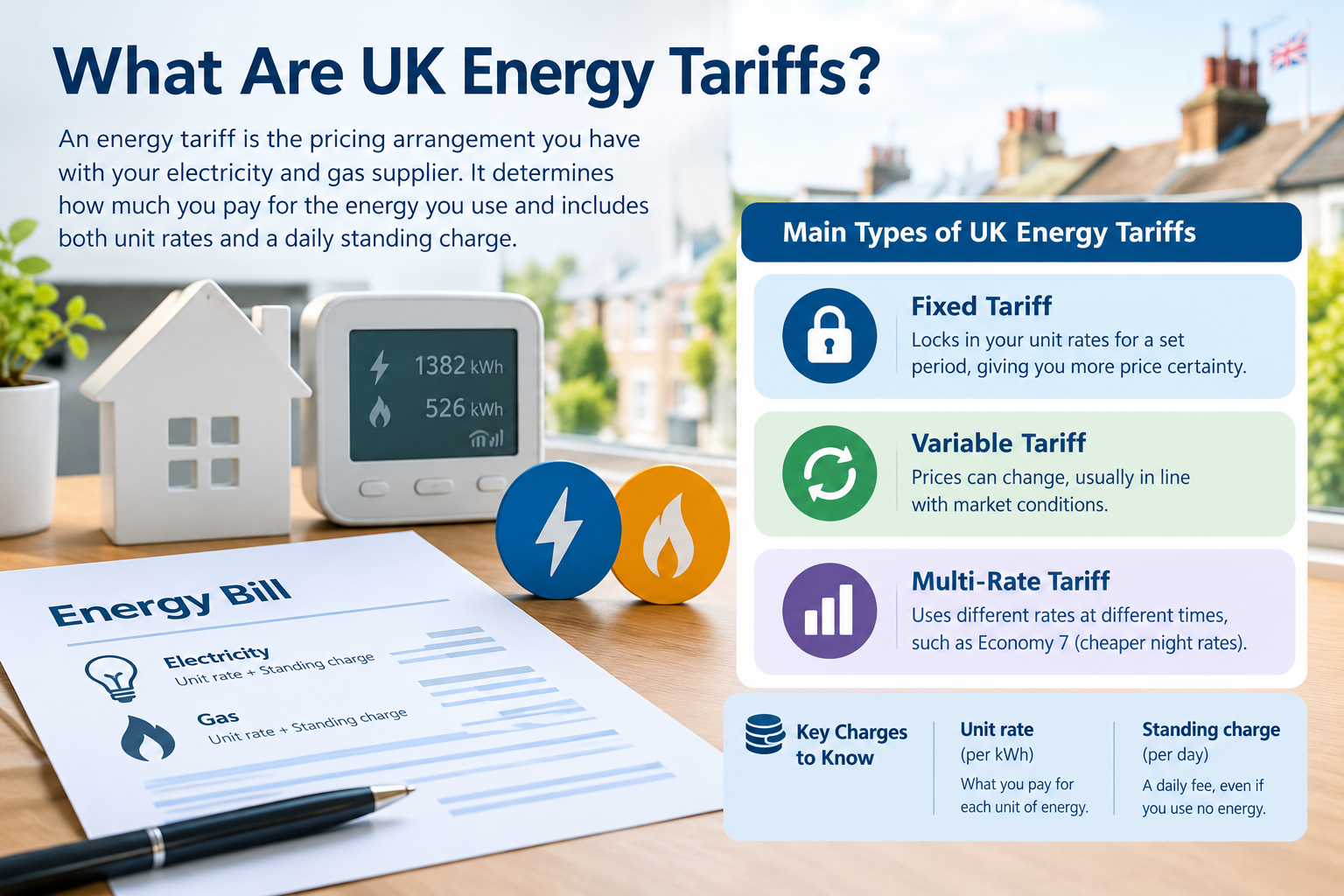
An energy tariff is the pricing arrangement you have with your electricity or gas supplier.
Your tariff normally includes two important charges:
- Unit rate: what you pay for each kilowatt-hour (kWh) of electricity or gas.
- Standing charge: a daily amount charged whether or not you use energy that day.
Ofgem identifies several main tariff types, including fixed-rate tariffs, standard variable tariffs and multi-rate tariffs such as Economy 7.
Your total annual cost is therefore influenced by both your unit rates and standing charges, as well as your actual energy consumption.
Fixed Energy Tariffs
A fixed tariff normally locks the unit prices for a specified period.
If wholesale energy prices rise after you sign the deal, your agreed unit rates generally do not rise during the fixed period.
However, fixing does not mean your total bill is fixed. If you use more electricity or gas, you will pay more because you are still charged for the energy you consume.
You may also face an exit fee if you leave the contract early.
Variable Energy Tariffs
A standard variable tariff, often called an SVT, allows prices to change.
For households on default tariffs in Great Britain, the Ofgem price cap limits the maximum unit rates and standing charges suppliers can charge under the cap rules. The cap is reviewed every three months.
Variable tariffs can therefore provide flexibility, but your rates can change when the supplier’s pricing changes.
Fixed vs Variable Energy Tariffs Compared
| Feature | Fixed Tariff | Variable Tariff |
|---|---|---|
| Unit price | Fixed for agreed period | Can change |
| Protection from price increases | Higher | Limited by applicable price-cap rules |
| Benefit if prices fall | Usually no | Yes, subject to tariff pricing |
| Exit fees | May apply | Usually more flexible |
| Budget predictability | Higher | Lower |
| Contract length | Usually fixed term | Usually ongoing |
| Best suited to | People who value certainty | People who value flexibility |
There is no universally best choice. The right tariff depends on your circumstances and the price offered to you.
What Is the UK Energy Price Cap?
The energy price cap is an Ofgem limit on the rates suppliers can charge customers on certain default tariffs in Great Britain.
It is important to understand what the cap does not mean.
It does not mean your household can only spend a certain amount each year. A household using twice as much energy can have a much higher bill than a household using less.
For 1 October to 31 December 2026, Ofgem’s average Direct Debit figures are:
- Electricity: 26.32p per kWh
- Electricity standing charge: 54.83p per day
- Gas: 7.97p per kWh
- Gas standing charge: 29.68p per day
- Typical annual price-cap level: £1,723
These are England, Scotland and Wales averages, and actual regional rates can differ.
The October 2026 cap represents a 4% increase compared with the previous price-cap period for a typical dual-fuel Direct Debit household.
A Key 2026 Change: Electricity VAT
From 1 October 2026, VAT was removed from household electricity bills until 31 March 2027 under the government’s temporary measure. Gas remains subject to 5% VAT during this period.
This is one reason consumers should be careful when comparing older energy-price information with current tariffs.
What Is the Best Energy Tariff UK Households Can Choose?
There is no single tariff that is cheapest for every household.
A tariff that looks attractive for a large family may not work as well for a small flat with low consumption. Similarly, a tariff with a low electricity unit rate could have a high standing charge.
When looking for the best energy tariff UK customers should compare:
1. Electricity Unit Rate
Check the price per kWh.
If your household uses a lot of electricity, a small difference in the unit rate can have a noticeable effect on your annual cost.
2. Gas Unit Rate
If you use gas heating, the gas unit rate can have a major impact on your total bill.
Do not compare electricity prices alone if you have a dual-fuel household.
3. Standing Charges
Standing charges are easy to overlook.
A tariff with a slightly cheaper unit rate may not be cheaper overall if it has significantly higher daily standing charges.
4. Estimated Annual Cost
The most useful comparison is normally the estimated annual cost based on your own consumption, rather than simply comparing headline unit rates.
5. Exit Fees
Check the tariff’s early-exit conditions before signing a fixed contract.
Ofgem confirms that fixed-rate customers may have to pay an exit fee when switching before the fixed period ends.
6. Payment Method
The price you pay can depend on whether you use Direct Debit, standard credit or a prepayment meter. Ofgem’s price-cap information varies according to payment method and other factors.
Pros and Cons of Fixed Energy Tariffs
Pros
- More predictable unit prices
- Protection from increases in the agreed rates
- Easier household budgeting
- Can provide certainty during periods of price volatility
Cons
- You could miss out if market prices fall
- Exit fees may apply
- A fixed deal is not necessarily cheaper than a variable tariff
- Your total bill can still increase if your energy usage increases
Pros and Cons of Variable Energy Tariffs
Pros
- Greater flexibility
- You can usually switch more easily
- You can benefit when market-linked prices fall
- No long fixed commitment in many cases
Cons
- Prices can rise
- Monthly bills are less predictable
- Future costs can be harder to budget
- A variable tariff is not automatically the cheapest option
How Much Do UK Energy Tariffs Cost?
The best way to think about energy costs is through unit rates + standing charges + usage.
For example, imagine a household uses:
- 2,700 kWh of electricity per year
- 11,500 kWh of gas per year
Using Ofgem’s average October–December 2026 price-cap unit rates as a simple illustration:
Electricity:
2,700 × £0.2632 = £710.64
Gas:
11,500 × £0.0797 = £916.55
These calculations are only an illustration and do not represent a complete annual bill because standing charges and regional differences also matter.
The example demonstrates why a household should compare total annual cost, not just one unit rate.
Should You Fix Your Energy Tariff in 2026?
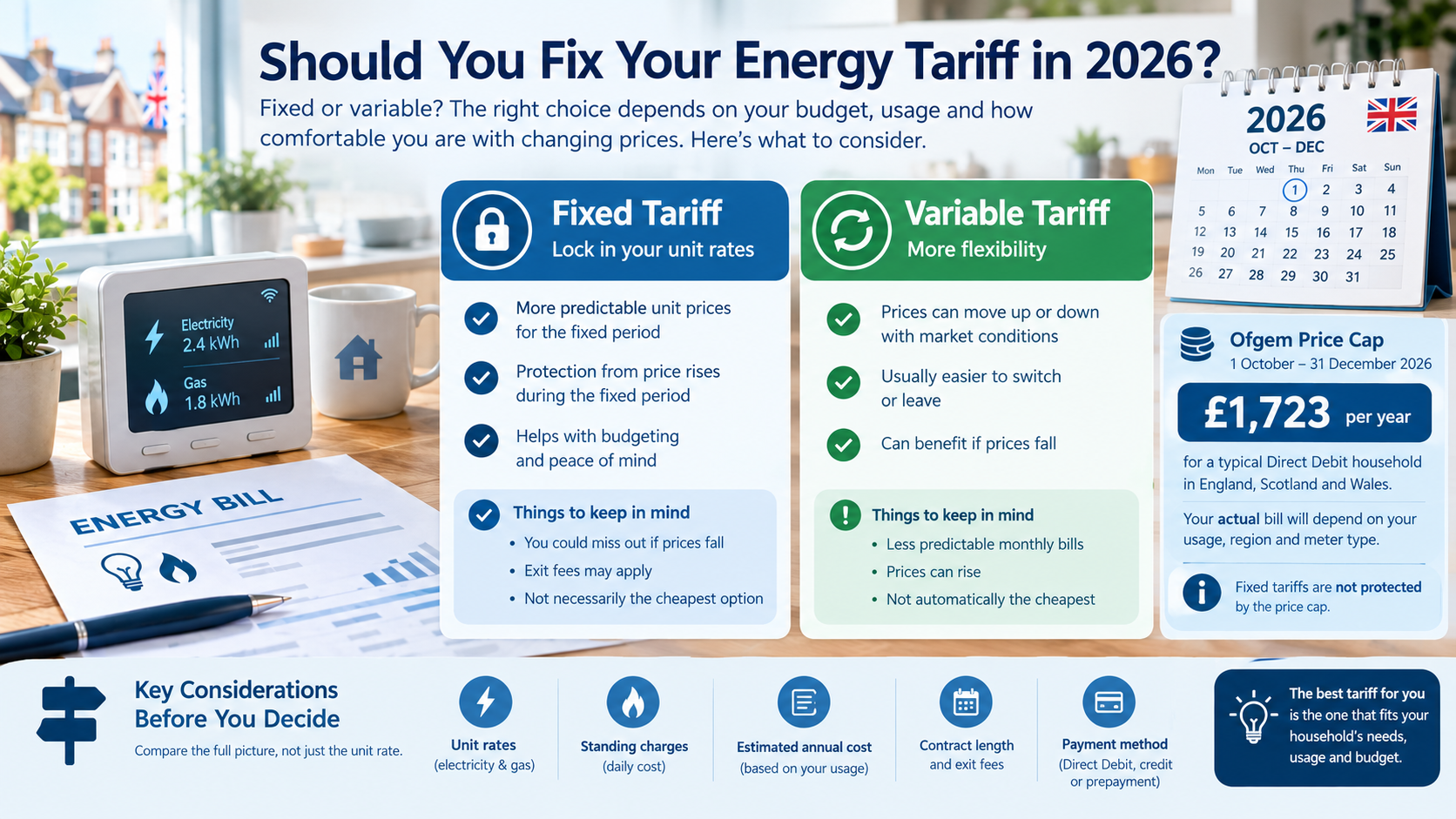
Fixing may make sense if you value predictable pricing and the fixed deal is competitive against the variable alternatives available to you.
You might prefer a fixed tariff if:
- You want greater certainty over your unit rates.
- You expect to remain at the property for the contract period.
- The fixed deal offers a worthwhile saving compared with your alternatives.
- The exit fee is acceptable.
A variable tariff may be preferable if:
- You want flexibility.
- You expect prices could fall.
- You do not want to pay an exit fee.
- The available fixed deals are not attractive.
The important point is to compare the actual deal offered to you rather than assuming that fixed or variable is always better.
How to Switch Energy Tariffs
Switching can be relatively straightforward.
Ofgem says consumers can switch supplier or tariff and should compare available deals before deciding. You will normally need information such as your postcode, current supplier, current tariff and annual energy usage.
A practical process is:
- Find your latest energy bill.
- Check your annual electricity and gas usage.
- Note your current unit rates and standing charges.
- Check whether your current contract has an end date.
- Check for exit fees.
- Compare available tariffs.
- Compare estimated annual costs.
- Check payment requirements and other conditions.
- Choose the tariff that fits your circumstances.
- Keep your meter readings and confirmation details.
Your new supplier normally manages the switching process.
Don’t Ignore Energy Support Schemes
Choosing a tariff is only one way to reduce energy costs.
The Warm Home Discount provides a £150 discount for eligible households during the 2026–27 scheme year. The scheme differs by location and eligibility rules, and it is not available in Northern Ireland.
Eligible households in England and Wales generally need to meet the relevant benefit and property requirements, with the person receiving the qualifying benefit named on the electricity bill.
If you think you might qualify, check the current government and Ofgem guidance rather than relying on older eligibility information.
Comparison/Cost Table
| What to Compare | Why It Matters | What to Check |
|---|---|---|
| Electricity unit rate | Affects every kWh used | Price per kWh |
| Gas unit rate | Important for gas-heated homes | Price per kWh |
| Electricity standing charge | Paid every day | Daily rate |
| Gas standing charge | Paid every day | Daily rate |
| Contract length | Determines how long rates are fixed | End date |
| Exit fee | Can make early switching expensive | Fee per fuel |
| Estimated annual cost | Gives a more useful overall comparison | Based on your usage |
| Payment method | Can affect applicable rates | Direct Debit, credit or prepayment |
| Tariff type | Determines pricing flexibility | Fixed, variable or multi-rate |
FAQs
Is a fixed energy tariff cheaper than a variable tariff?
Not necessarily. A fixed tariff can provide price certainty, but whether it is cheaper depends on the rates offered, your energy consumption and how variable prices change.
What is the UK energy price cap in October 2026?
For 1 October to 31 December 2026, Ofgem’s average price-cap level is £1,723 per year for a typical Direct Debit household in England, Scotland and Wales. It is not a maximum on the amount an individual household can spend.
Can I switch energy tariffs whenever I want?
Generally, variable/default tariff customers can switch, while fixed-tariff customers may face an exit fee if they leave before the contract ends. Always check your current terms.
Does the energy price cap apply to fixed tariffs?
No. Ofgem states that customers who have agreed a fixed tariff are not protected by the price cap in the same way as customers on applicable standard variable tariffs.
Are standing charges included in energy prices?
Yes. Your energy bill includes standing charges as well as charges based on the amount of electricity or gas you consume.
Should I compare electricity and gas separately?
Yes. Even if you have one supplier for both fuels, compare the electricity rate, gas rate and standing charges. A dual-fuel tariff is not automatically the cheapest option.
Can I get help with my energy bill?
Some households may qualify for schemes such as the Warm Home Discount. For winter 2026–27, the Warm Home Discount is a £150 bill discount for eligible households.
Is the cheapest unit rate always the best tariff?
No. You should also consider standing charges, estimated annual cost, contract length, exit fees and your expected energy consumption.
Conclusion
The best energy tariff UK households can choose is not necessarily the tariff with the lowest advertised unit rate. The better choice is the deal that provides the right balance of annual cost, pricing certainty, flexibility and contract conditions for your household.
As of 8 October 2026, Ofgem’s price cap for 1 October–31 December is £1,723 a year for a typical Direct Debit household, but individual bills vary according to usage, location and tariff.
Before switching, check your current usage, compare unit rates and standing charges, look for exit fees and consider whether a fixed or variable deal better matches your circumstances